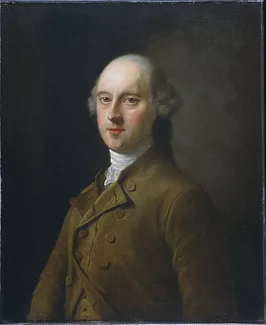
Perhaps one of the most underrated events of 1775 in Revolutionary America was the transmission of secret orders from William Legge, 2nd Earl of Dartmouth (1731-1801) and His Majesty’s Secretary of State for the American Department, to Gen. Thomas Gage, military governor of Massachusetts and commander of the British army in North America, to end the colonial insurgency by force if necessary.
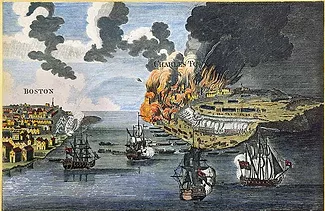
The Battle of Bunker Hill, fought on June 17, 1775, marked a critical moment in the American Revolution. It was part of the Siege of Boston, an early and bloody conflict between British forces and American colonists.
After the bloody events at Lexington and Concord on April 19, 1775, the New England militia began to encircle Boston, placing the British garrison under siege. Before the American Revolution, troops in Boston relied heavily on local farmers for fresh provisions. General Thomas Gage would be forced to depend upon a long and tenuous supply line to Nova Scotia and England if these local supply sources were disrupted. Massachusetts leaders understood that it was unlikely that they could entirely cut off the flow of supplies to the British army. Still, if they could significantly cut into it, they might starve the British out of Boston.
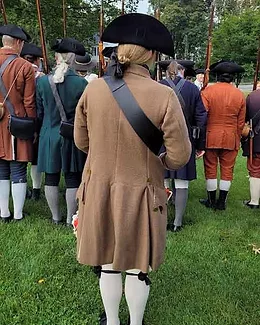
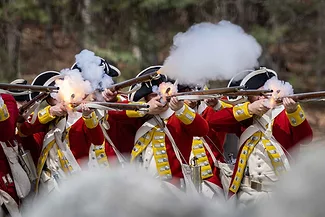
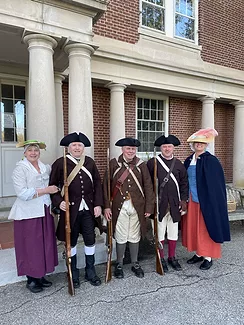
The reenactment group, His Majesty’s Tenth Regiment of Foot, American Contingent (the Tenth Regiment), was founded on July 15, 1968, by Chelmsford native Vincent J-R Kehoe. Having seen the earlier reenactments at the Old North Bridge in Concord, where men portrayed British Regulars by dressing up in red bath robes and papier mâché caps, Kehoe had a vision to accurately portray and honor the British soldiers who fought at the Battles of Lexington and Concord on April 19, 1775. Kehoe selected the Tenth Regiment out of the numerous British regiments in Boston in 1775 as an homage to his own service in the United States Army 10th Mountain Division in WWII.
The Battle of Menotomy was a skirmish fought as the British retreated to Boston on April 19, 1775. The fight, often overshadowed by the Battles of Lexington and Concord, was brutal and bloody.
After the Battles of Lexington and Concord, British troops retreated to Boston. However, they were relentlessly harassed by thousands of militiamen who ambushed them from the surrounding woods and houses. The British soldiers, now under constant fire, were forced to slow their pace and fight their way back to safety.
The Battles of Lexington and Concord, fought on April 19, 1775, marked the outbreak of the American Revolutionary War. The British, seeking to suppress a growing colonial rebellion, dispatched 700 elite troops under the command of Lieutenant Colonel Francis Smith to seize a stockpile of arms and ammunition in Concord, Massachusetts. News of this impending operation quickly spread through the colonial network, alerting local militias.
The operation began with British troops crossing the Charles River to Cambridge and marching toward Concord under darkness. The confrontation began at Lexington Green, where a small contingent of colonial militiamen, under the command of Captain John Parker, faced a significantly larger British force. As the Regulars approached the town common, Parker told his men to “Stand your ground, don’t fire unless fired upon, but if they mean to have a war, let it begin here!”1
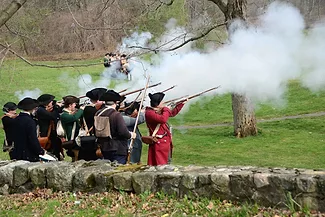
Each year, hundreds of thousands of visitors from across the globe come to Concord, Lexington, and the surrounding towns to witness the time-honored traditions, tactical demonstrations, and festive commemorations that pay tribute to the first battle of the American Revolution. These amazing living history moments are only possible with the dedication and support of hundreds of passionate historical reenactors who work year-round to ensure the stories of our nation stay alive in the hearts and minds of visitors to our national parks.
Americans have a deep reverence for those who perished in military service. Communities remember those who died during their service by providing free military gravestones, placing flags on graves, and erecting monuments or memorials. The soldiers who died during the Revolutionary War were America’s first veterans. Here in Concord, there has been a long-standing tradition each Memorial Day of reading the names of those who died in service. Until 2023, only one name was read for the Revolutionary War: Reverend William Emerson. For as long as anyone could remember, he was the only person remembered by the town for dying during his service in the Revolutionary War.
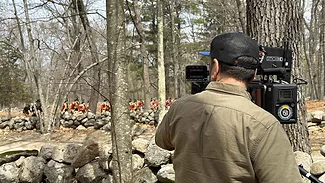
The American Revolution, a new six-part, 12-hour series directed by Ken Burns, Sarah Botstein, and David Schmidt and written by Geoffrey Ward will premiere on PBS on November 16, 2025. The series examines how America’s creation turned the world upside-down. Thirteen British colonies on the Atlantic Coast rose in rebellion, won their independence, and established a new form of government that radically reshaped the continent and inspired centuries of democratic movements around the globe.
The Battle at the North Bridge on April 19, 1775, was well documented, but the running battle of the minutemen and militia companies chasing the Regular Army out of Concord back to Charlestown along what we now call Battle Road is lesser-known. Records are incomplete and make the first five miles of the retreat impossible to reconstruct accurately. Nevertheless, the National Park Service has hunted down slender clues to provide a more complete history to the forgotten families who experienced fighting on their front lawns. Minute Man National Historical Park Ranger Jim Hollister was able to share some stories about families that lived on the Battle Road.