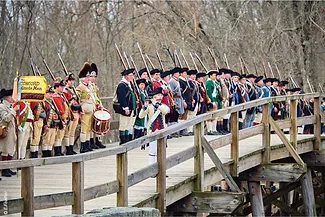
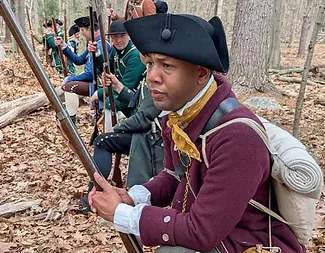
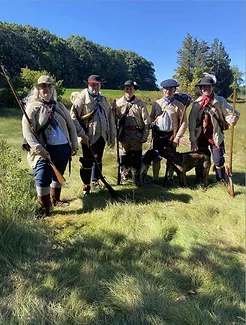
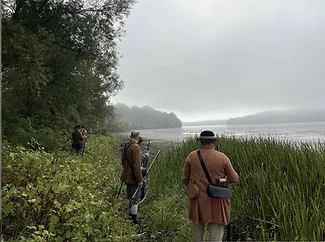
This year's Patriots' Day honored the 250th anniversary of the first battles of the American Revolution with great fanfare, historic reenactments, commemorations, and somber remembrance of those who gave their lives to help give rise to the United States of America. As we make our way towards July 4, 2026, and the America250 celebrations, we hope you will enjoy a look back at the events of April 19, 2025.
Stand in the middle of Concord’s North Bridge with the Minute Man statue on your right and the British soldiers’ grave on your left. Place your hands on the rough wooden handrail in front of you; slightly to the left, you will see The Old Manse through the trees. Peer down into the Concord River that Ralph Waldo called “the dark stream which seaward creeps” and brace yourself: this tale is about to get rough.
In the early morning hours of December 9, 1775, the peaceful marshland near the village of Great Bridge, Virginia, was abruptly interrupted by the booming sound of British cannons and the crack of musket fire. This marked the beginning of a swift but significant Patriot victory that not only expelled British authority from Virginia but also fueled the growing movement for American independence.
In the shadow of Lexington and Concord, away from Boston’s protests and the assembled New England militiamen, the American Revolution initially took hold in the Southern backcountry at Savage’s Old Fields. Situated near the township of Ninety-Six, South Carolina, this site witnessed a brief yet pivotal siege that underscored the fragile nature of political restraint in a divided colony and foreshadowed the brutal civil conflict that would soon engulf the region.
On the morning of October 18, 1775, the coastal town of Falmouth—now known as Portland, Maine—awoke to the ominous sound of British naval cannon fire. For over nine hours, incendiary shells, bombs, and grapeshot rained down upon the bustling seaport, igniting more than 400 buildings and leaving over 1,000 residents homeless on the brink of a harsh New England winter.
n the fall of 1775, a cold, muddy siege took place along the Richelieu River, marking the Continental Army’s first major operation outside the Thirteen Colonies. The Siege of Fort St. Jean, from September 17 to November 3, was a harsh and prolonged conflict. This campaign exposed the fragile beginnings of America’s revolutionary efforts and set the stage for future challenges in Canada.
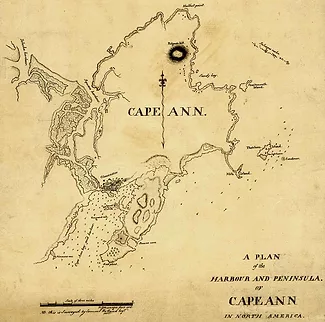
After the Battle of Bunker Hill, British officials in Boston decided that several coastal towns to the north—including Salem, Beverly, Ipswich, Newburyport, and Gloucester—likely served as supply hubs for the American forces surrounding the city. As a result, these towns became important targets for British naval attacks and landings.
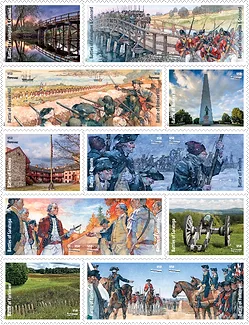
As America celebrates the 250th anniversary of the first battles of the American Revolution, the United States Post Office is commemorating the occasion with 15 new stamps memorializing five turning points in the fight for American independence.
After telling the tale of The Midnight Ride of Paul Revere, Henry Wadsworth Longfellow ended his epic poem with the words, “The rest you know from the books you have read.” But in case you haven’t read books about the battles at Lexington and Concord, Cape Cod artist Karen Rinaldo will sum it up for you in a single piece of art, currently on display at the Concord Museum.
Centuries had passed since legendary King Arthur pulled a sword from a stone claiming his right to the throne of England, but, once more, swords were being pulled in King Arthur’s land as guards tried to repel a crowd surging forward to get a glimpse of captive Patriot Ethan Allen and some of his Green Mountain Boys as they were dragged towards Pendennis Castle in Cornwall, England.