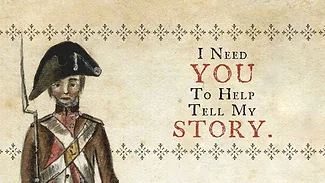
The American Revolution, a new six-part, 12-hour series directed by Ken Burns, Sarah Botstein, and David Schmidt and written by Geoffrey Ward will premiere on PBS on November 16, 2025. The series examines how America’s creation turned the world upside-down. Thirteen British colonies on the Atlantic Coast rose in rebellion, won their independence, and established a new form of government that radically reshaped the continent and inspired centuries of democratic movements around the globe.
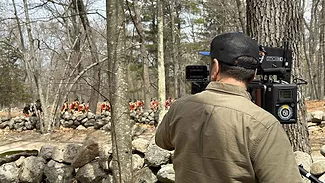
Discover Concord magazine had the privilege of speaking with the filmmakers about their experience here in the Concord and Lexington area and what it meant to them to film such an important documentary about the war that would launch the United States of America into being.
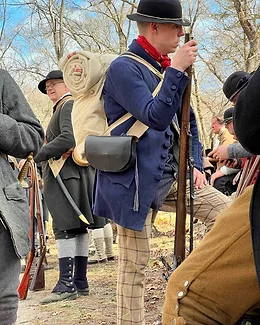
Since 2000, many reenactors have asserted that haversacks were commonly worn by Massachusetts militia and minute companies when they fielded against British forces on April 19, 1775. The two most common arguments advanced have been that militia and minutemen were in possession of haversacks because they were previously issued to Massachusetts troops during the French and Indian War, or that the item was acquired on the eve of the American Revolution from a third-party source.
Early this year, National Park Service archeologists working at Minute Man National Historical Park discovered five musket balls that were fired during the
world-changing event known as “The Shot Heard Round the World” on April 19, 1775.
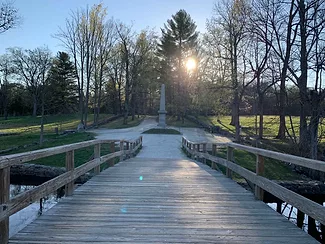
Early analysis of the 18th-century musket balls indicates they were fired by colonial militia members at British forces during the North Bridge fight.
April 19, 1775, marked the first battle of the American Revolution. On that day, 700 British soldiers marched from Boston to Concord to seize a stockpile of military arms and supplies. The expedition caused patriot leaders to raise the alarm and muster the militia. The scale of the response is truly staggering and hints at a surprising amount of organization.
When did the American Revolution begin? At the North Bridge on April 19, 1775, with “the shot heard round the world”? In Philadelphia on July 4, 1776, with the Declaration of Independence? John Adams thought the Revolution was over by the time the first guns were fired. It “was effected in the minds and hearts of the people.”
Arguably, that crucial turning-point occurred in Concord two hundred fifty years ago, when on October 11, 1774, delegates from all over Massachusetts, roughly 243 representatives from close to 200 towns, including the District of Maine, gathered in the Congregational meetinghouse (now First Parish) to deal with “the dangerous and alarming situation of public affairs” touched off by Britain’s harsh reaction to the Boston Tea Party.
Isabel Bliss hurried her three children, aged four through seven, off to bed on the night of March 20, 1775. The two men who had come to her door looked like local farmers seeking counsel from her husband, lawyer Daniel Bliss. They wore the homespun coats of plain country folk, but the muskets they carried told a different story.
As the men huddled with Daniel in the parlor, talking in whispers, Isabel was startled by another knock at the door. She opened it cautiously and was relieved to see the familiar face of a neighbor. The woman was out of breath, and tears stained her cheeks. She begged Isabel to forgive her, because she had given the two strangers directions to the Bliss home without knowing who they were.
On Monday, September 2, 2024 (Labor Day), Lafayette reenactor Benjamin J. Goldman will come to First Parish in Concord, commemorating the day and site where the town gave the French general a hero’s welcome two hundred years ago. The public is warmly invited to assemble on the lawn of First Parish to watch a reenactment of Lafayette’s visit to Concord at 3:00 this Labor Day.
As hostilities grew between Massachusetts and the English government in the 1770s, popular opinion was divided. Concord’s “patriot preacher,” Rev. William Emerson, spoke out for liberty and served as chaplain for Concord’s Minutemen. Meanwhile, his brother-in-law, lawyer Daniel Bliss, remained loyal to the King, and would be forced to flee for his life to Canada when war erupted in 1775.
With the end of the French and Indian War in 1763, Great Britain was now in control of North America: the 13 British colonies along the seaboard were safe and sound from their enemies, while all French territory east of the Mississippi, as well as Spanish Florida, now belonged to King George III. For the first time since 1701, Great Britain was at peace. But the empire was also broke.


.webp?height=325&t=1724274643&width=325 "G299-Concord-Museum-20220003-(1).jpg")