
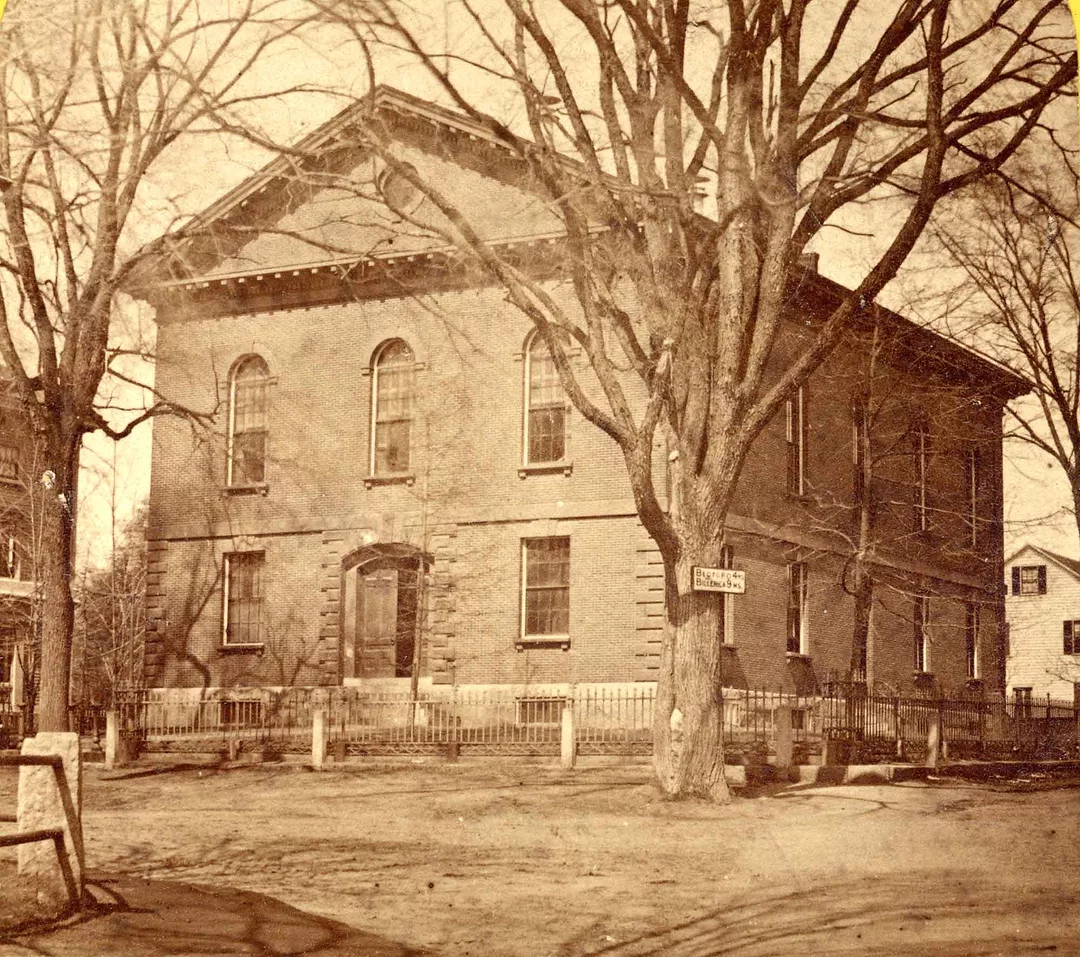
The Lyceum Movement started in New England in 1826, when educator and scientist Josiah Holbrook founded the first lyceum in Millbury, Massachusetts. Inspired by the classical Lykeios (Λύκειος) in Ancient Greece, where Aristotle taught, the movement was created to bring education to ordinary people through lectures, debates, and readings. Lyceums quickly spread across New England, fostering education, self-improvement, and civic engagement, and many towns soon formed lyceums of their own, including Boston in 1829 and Salem in 1830. By the 1830s, there were Lyceums across the country.
Concord would soon join the movement. On December 3, 1828, “a large and respectable meeting of citizens of Concord was convened…to take into consideration the expediency of forming a Lyceum in Concord” expressly for the purpose of “improvement in knowledge, the advancement of Popular Education, and the diffusion of useful information throughout the community.” A commission was formed, and two weeks later a constitution was drafted to create the Concord Lyceum. Officers—made up of the town’s VIPs and civic leaders—were chosen to lead the new organization. They included the Reverend Dr. Ezra Ripley, Reuben Brown, Cyrus Hosmer, and Daniel Stone.
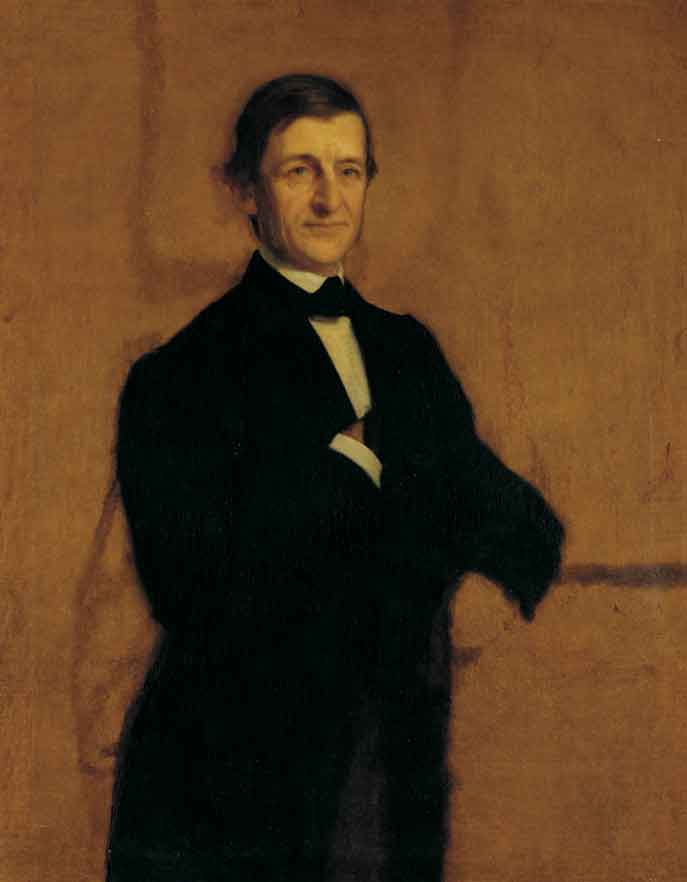
Ralph Waldo Emerson in 1867. By William Henry Furness, Jr.
| Commons.wikiedia.org. Public domainThe Lyceum was open to “any person living within the Centre School District in Concord…by annually paying into the treasury one dollar, and [to] any person living without the limits of said district, by the payment of fifty cents.” Furthermore, “Ten dollars paid at any one time shall entitle a person to one membership for life.” Fifty-seven Concordians signed the Constitution, with four men paying the $10 (about $340 in today’s money) to become life members.
From the very beginning, the Concord Lyceum was a success. The first lecture was delivered by Reverend Bernard Whitman of Waltham, Massachusetts, on Wednesday, January 28, 1829. His subject was “Popular Superstitions,” and it was a full house. The Concord Yeoman’s Gazette reported, “Full three hundred hearers were present, some of whom came from adjoining towns.”
For the first five years of the Lyceum, nearly all meetings were held in the Concord Academy building on Academy Lane. In 1833, lectures were moved to the Centre School (the Masonic Temple) on the town square because the Academy was deemed “too far from the centre of the village” for easy access. The Lyceum later met in the vestries of the Unitarian and Congregational churches, and eventually in the Town Hall after that building was erected in 1851.
Starting every October and held throughout the winter season, the wide range of lectures and debates was impressive, covering a variety of subjects, including moral, political, and religious issues. Science, history, literature, chemistry, geometry, hydrostatics, astronomy, electricity, botany, and ornithology were all lectured on and discussed. Among the topics were “The Natural History of Man,” “First Continental Congress,” “Common School Education,” and “Influence on the Moral Character of the Nation.” The Lyceum served as a vital cultural hub for the town, offering residents access to the leading thinkers and speakers of the day.
Some of the biggest names in American intellectual history appeared at the Lyceum: Horace Greeley, the influential newspaper editor, and Theodore Parker, a prominent minister and abolitionist. Dr. Oliver Wendell Holmes, Sr., the renowned poet and physician, spoke on (fittingly enough) “Lyceums and Lyceum Lectures.” James Russell Lowell lectured on “Dante.” Louis Agassiz, the renowned naturalist and geologist, appeared before the Lyceum, as did Henry Ward Beecher, the famous clergyman.
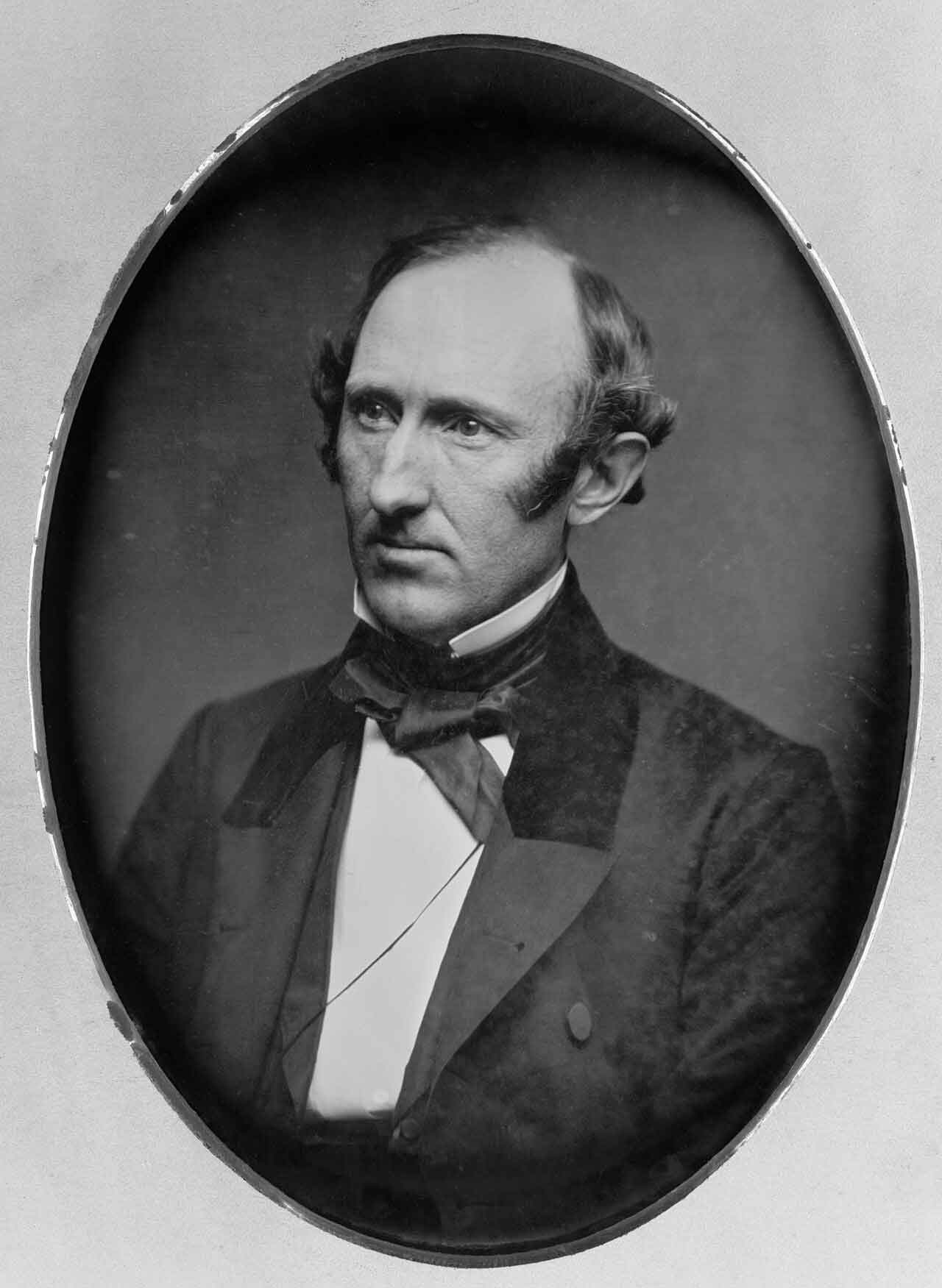
Wendell Phillips
| Commons.wikiedia.org. Public domainAnti-slavery lectures were allowed, but not without significant controversy. While Concord was generally receptive to such topics, public expressions of anti-slavery sentiment often divided the town. Abolitionist Wendell Phillips spoke three times between 1842 and 1845, and each appearance was met with disapproval from more conservative Concordians. When Phillips was asked to appear for the 1844–1845 season, two of the Lyceum curators, Reverend Barzillai Frost and John Shepard Keyes, promptly resigned. William Whiting—a diehard Concord abolitionist—was chosen president pro tem, and Frost and Keyes were replaced by Samuel Barrett and Henry Thoreau. Phillips spoke for the third time before the Lyceum on March 11, 1845.
Henry Thoreau would write an anonymous letter to The Liberator in defense of Phillips’ right to speak, which William Lloyd Garrison published in his March 28, 1845, issue:
“We must give Mr. Phillips the credit of being a clean, erect, and what was once called a consistent man. He at least is not responsible for slavery, nor for American Independence; for the hypocrisy and superstition of the Church, nor the timidity and selfishness of the State; nor for the indifference and willing ignorance of any…We consider Mr. Phillips one of the most conspicuous and efficient champions of a true Church and State now in the field, and would say to him, and such as are like him, ‘God speed you.’”
Thoreau himself would occasionally appear at the Lyceum. The first lecture he ever delivered was on April 11, 1838, with the topic being “Society.” He would go on to give twenty more lectures at the Concord Lyceum over the next twenty-two years, and many of his best-known works began as lectures, including talks on his life at Walden Pond and his excursions to Cape Cod. In January and February 1848, he would lecture on “The Relation of The Individual to the State,” a talk that has since become one of the most influential political works in American literature: “Civil Disobedience.”
Thoreau would also lecture at the Lyceums in Lincoln, Salem, and New Bedford, Massachusetts. One of these lectures, called “What Shall it Profit?” would be published posthumously as “Life Without Principle.” He also read “Walking” – which he delivered ten times between 1851 and 1860, more than any of his other works. Still, Thoreau wasn’t particularly keen on lecturing. He felt that he was “cheapening” himself by lecturing and he had little desire to seek fame or popularity. Indeed, Thoreau reveled in what he called “the advantages of obscurity,” and he would lecture only 75 times in his lifetime.
Ellery Channing was Henry Thoreau’s best friend, a frequent companion on many of Thoreau’s daily walks. While he was not particularly interested in lecturing, he did deliver a talk called “Society” before the Lyceum on January 29, 1852. Ellery’s mother-in-law, Mrs. Margaret Crane Fuller, thought it “rich...brilliant, and witty.” But Thoreau was not so impressed:
“Heard C. lecture to-night. It was a bushel of nuts…all genius, no talent…I cannot associate the lecturer with the companion of my walks. It was from so original and peculiar a point…that I doubt if three in the audience apprehended a tithe what he said.”
Ralph Waldo Emerson was the most famous man in Concord and an important part of the Lyceum. He served for a time as a curator and would persuade friends and acquaintances to come to Concord to speak. More often than not, speakers from out of town would be entertained for the evening at his home either before or after the lecture. Bronson Alcott would report in his journal on one such eminent guest:
“Meet Agassiz at Emerson’s. He is here to lecture before our Lyceum…The lecture is listened to with profound interest…After the lecture, meet many of our people at Emerson’s, and have further talk with-the Professor. With his knowledge of the facts of the world, what might not an idealist like myself accomplish for the mind!”
Emerson was the Lyceum’s most frequent speaker, delivering more than 100 lectures to his fellow townspeople over the course of five decades. He viewed his Concord talks as a service to the community, and he would always appear at the Lyceum at no charge. Over the years Emerson came to consider the Lyceum his “pulpit” and, like Thoreau, many of his talks served as early drafts for his essays. “Human Culture” in 1838, “The Poet” and “The Transcendentalist” in 1841, and “Concord Walks” / “Country Life” in 1867 were all delivered at the Lyceum before seeing print.
This isn’t to say that all who attended Emerson’s lectures were Transcendentalists, nor did his audiences necessarily understand what he was talking about. His son, Edward Emerson, related a story of a Concord woman who was going to hear one of his father’s lectures. When asked if she understood what Emerson was speaking on, she replied, “Not a word, but I like to go and see him stand up there and look as if he thought everyone was as good as he was.” A newspaper article, writing on Emerson’s appearance at an Iowa Lyceum in 1855 reported, “We do not know what Emerson said, nor do we know the title of the talk, if there was one. A reporter in the audience said that the presentation confirmed that [Emerson] writes and reasons well.”
The heyday of the Concord Lyceum was from the mid-1830s to the 1850s. After the Civil War, it transitioned from intellectual debates and lectures into a broader forum featuring musical performances, entertainment, and a wider variety of speakers. Programs moved away from the serious and philosophical lectures that dominated the 1850s and increasingly included musicals, dramatic theatricals, and varied entertainments to attract a wider audience. For instance, the 1873–1874 Lyceum season featured Emerson, suffragist Mary A. Livermore, and polar explorer Isaac Hayes, as well as musical entertainment from the Mendelssohn Quintette Club and a program featuring “Black’s Stereopticon,” a twin-lensed, high-powered lantern that projected still image “picture plays” in a rapid-fire sequence, accompanied by spoken dialogue. It was reported that audiences were “held spellbound” by the lectures that incorporated the stereopticon’s images.
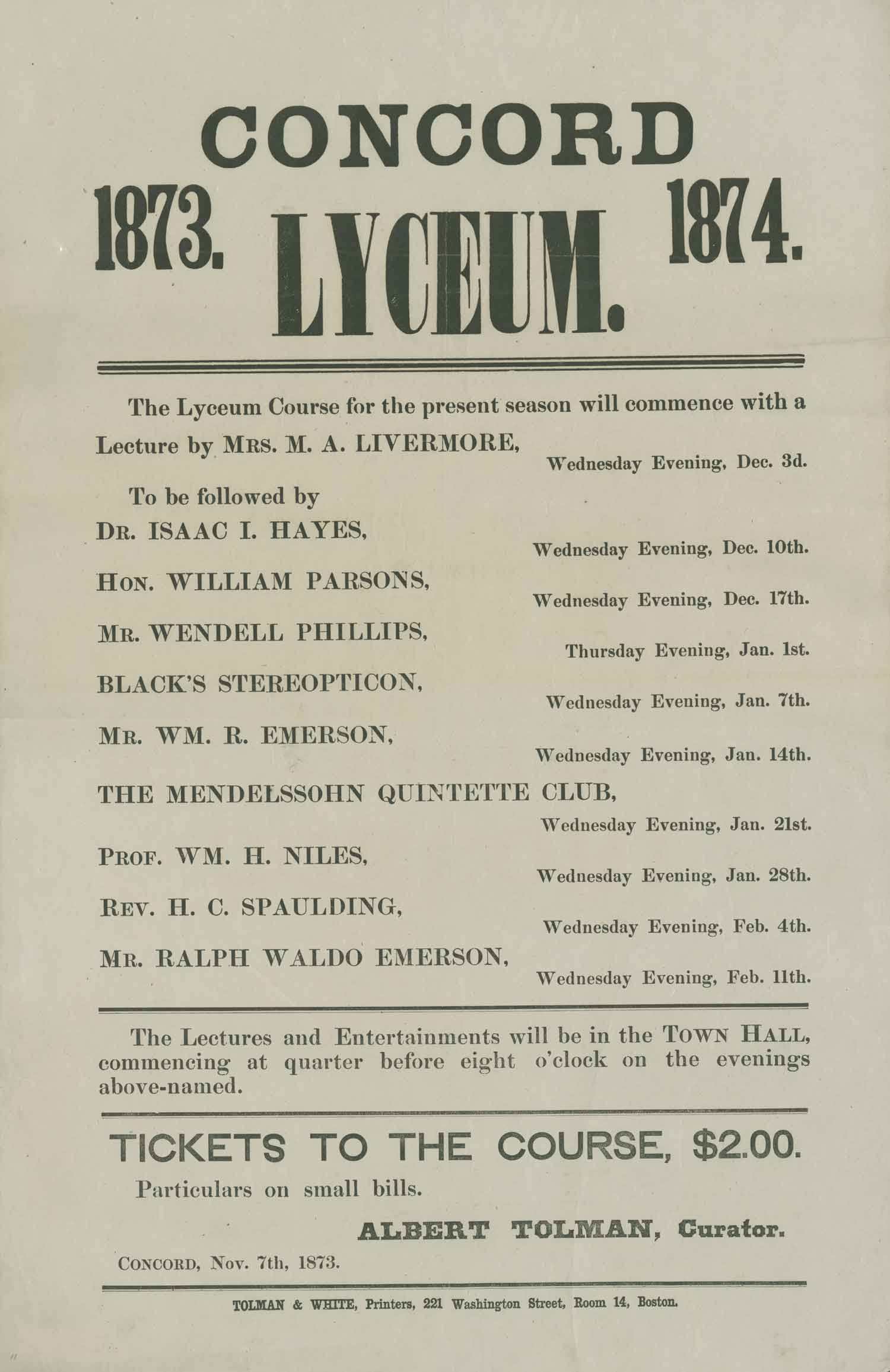 Courtesy of the Concord Free Public library
The 1880s saw the Concord Lyceum losing its luster. Many of the stars of the Lyceum were either dead or well into old age, leaving a younger generation that was uninterested in the movement. By the 1890s, new forms of leisure and popular culture, such as theater, early cinema, and professional sports, were becoming more accessible and preferred over intellectual lectures.
Around 1900, the Lyceum faced financial difficulties and eventually handed over its entertainment functions to other specialized musical and dramatic organizations in Concord. The very idea of a Lyceum seemed nostalgic, seen more as a historic symbol of “Old New England” than as a contemporary political force—a part of the good old days when Concord was the literary center of the world. By 1928, it had transformed from its 19th century role as a radical intellectual hub into a community institution focused on preserving the town’s prestigious literary legacy.
Throughout the 19th century, the Concord Lyceum served as a vital role for intellectual growth and community discourse, becoming a central pillar of Concord’s cultural life. By the 20th century, it was gone. But the speakers who appeared at the Lyceum will not be forgotten. They left behind a rich intellectual legacy that belongs not only to Concord, but to anyone who appreciates great deeds, great thoughts, and the power of the spoken word.