
The William Munroe Special Collections at the Concord Free Public Library has recently expanded one of the nation’s most significant archives devoted to Louisa May Alcott and her remarkable family. With the acquisition of several newly discovered letters by Alcott and two important collections assembled over decades, the Library has added new layers of insight into the life, work, and legacy of the author of Little Women.
For scholars, readers, and historians alike, these materials offer rare glimpses into Alcott’s creative process, her relationships, and the literary world in which she worked. The Concord Free Public Library’s William Munroe Special Collections already holds one of the most important repositories of Alcott manuscripts, correspondence, and related materials; these recent additions further strengthen Concord’s place at the center of Alcott research.
Among the most exciting acquisitions is a letter from Louisa May Alcott to her publisher, Thomas Niles of Roberts Brothers, written around 1868 while Little Women was in preparation. In it, Alcott provides editorial notes regarding the novel’s publication, revealing the author’s active role in shaping the book that would soon become an enduring classic of American literature.
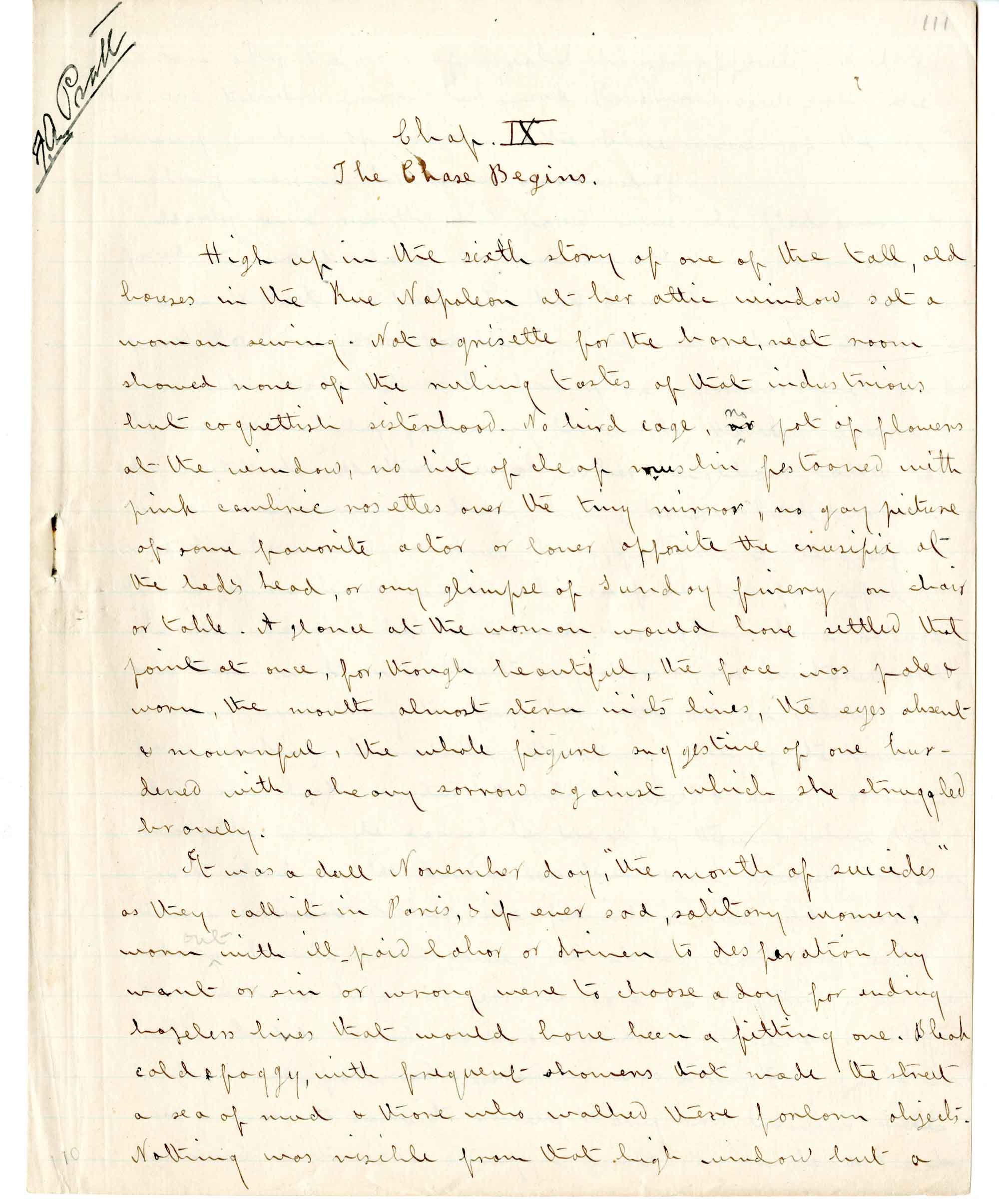
Louisa May Alcott. Manuscript of A Long Fatal Love Chase. Chapter IX, “The Chase Begins.”(Mather Collection)
Other letters provide a more intimate window into Alcott’s personal life. In three letters to her British friend Ellen Humphreys, Alcott writes about the death of her beloved sister, Abigail May Alcott Nieriker, the gifted artist known as May Alcott, who died shortly after giving birth to her daughter, Louisa May “Lulu” Nieriker. The correspondence reflects both grief and affection, offering a deeply personal perspective on a pivotal moment in the Alcott family’s history.
The letters also illuminate how Alcott understood her own literary creations. In one, she comments directly on the relationship between herself and Jo March, the spirited heroine of Little Women: “‘Jo’ is not myself any more than the others are my sisters, only suggestions of the four real girls.” In another, written while negotiating a magazine contribution, Alcott reveals the practical realities of professional authorship with characteristic directness: “I do not write anything for less than $100 & the length makes no difference.”
Taken together, these documents reveal a writer who was at once imaginative, reflective, and keenly aware of the value of her work. They deepen our understanding of Alcott’s approach to writing for young readers and her reflections on the characters who would come to shape generations of literary culture.
These individual manuscripts are complemented by two larger collections that dramatically broaden the Library’s Alcott holdings. In the fall of 2024, the nonprofit Library Corporation purchased a significant Alcott Family Collection assembled over decades by Kent Bicknell, a long-time Alcott editor, collector, and co-founder of Sant Bani School in central New Hampshire. Particularly notable for its representation of the wider Alcott family, the collection includes several paintings and unpublished letters by May Alcott, whose artistic achievements formed an important part of the family’s creative legacy. The collection also contains a rare 1876 Russian edition of Little Women and the manuscript of Louisa May Alcott’s dramatic piece “Mrs. Jarley’s Waxworks.”
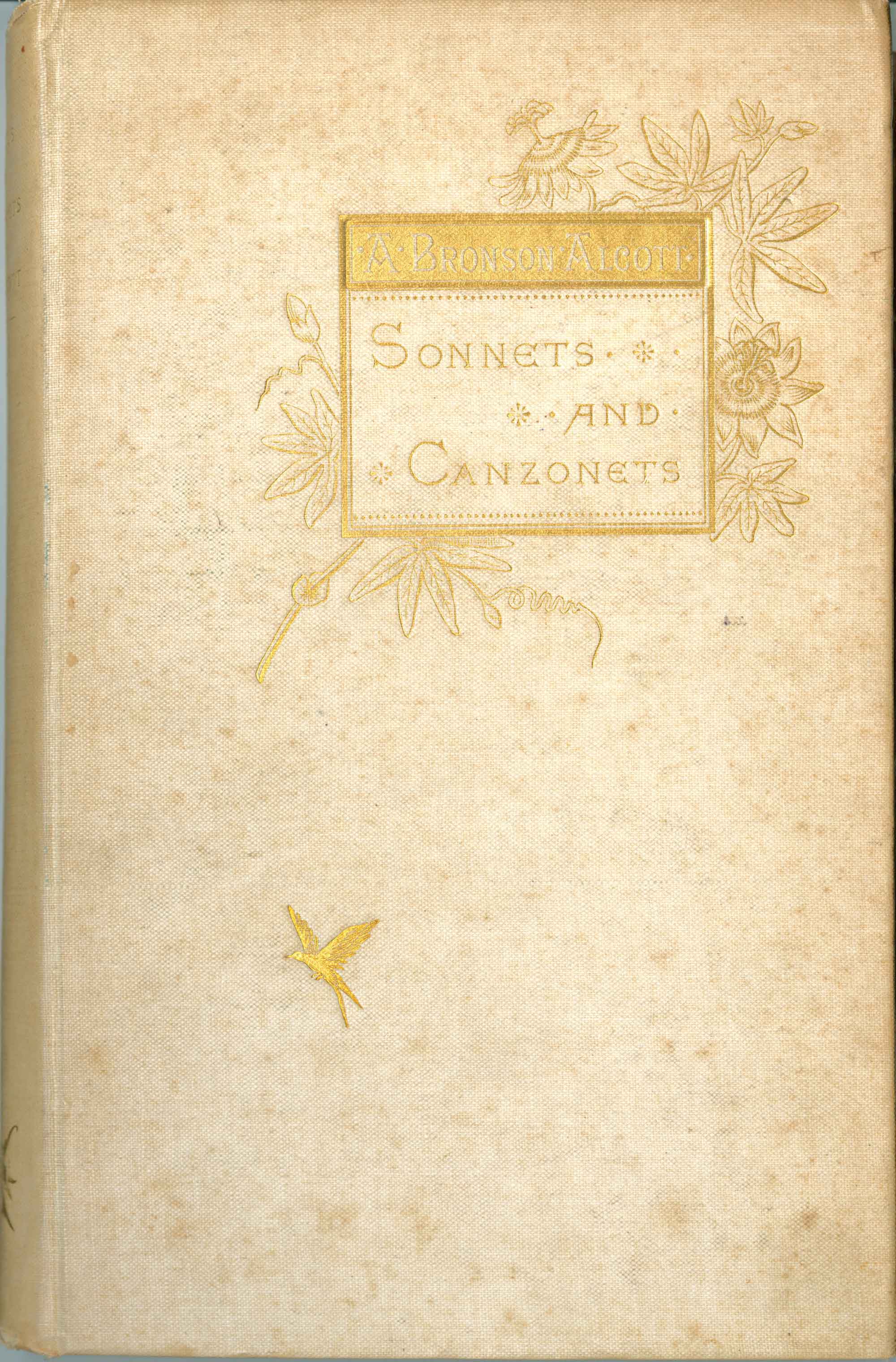
A. Bronson Alcott. Sonnets and Canzonets. Boston: Roberts Brothers, 1882. (Bicknell Collection)
| Courtesy of Concord Free Public LibraryThe acquisition of this collection soon led to an even more significant development. In 2025, the Library received the Mather Alcott Family Collection as a major gift from Colorado entrepreneur Timothy Mather. Although the two collections have separate ownership histories, both were assembled with the guidance of Dr. Bicknell, who served as curator and advisor to Mr. Mather’s collection. At Dr. Bicknell’s recommendation, Mr. Mather chose to donate his materials to the Concord Free Public Library, in honor of Sant Bani School and with the understanding that the collection would “be treasured, enhance current holdings, stay together, and be available for all to access.”
The Mather Alcott Collection contains several remarkable items, including letters from Louisa May Alcott to Thomas Niles discussing the illustrations for the first edition of Little Women. It also includes an unpublished letter written in 1841 by A. Bronson Alcott, in which he enthusiastically declares, “Eden is being planted in New England as fabled Paradise of yore”—a reference to the utopian community of Fruitlands. Perhaps most striking of all is the original manuscript of Louisa May Alcott’s gothic thriller A Long Fatal Love Chase. This novel remained unpublished until 1995, when its appearance made it an unexpected New York Times bestseller.
Together, these extraordinary acquisitions reinforce the Concord Free Public Library Corporation’s long-standing commitment to preserving the region’s literary and historical heritage. By bringing these manuscripts and collections to Concord—where the Alcotts lived, worked, and wrote—the William Munroe Special Collections ensures that new generations of readers and researchers will continue to explore the enduring legacy of one of America’s most beloved literary families.
—————————————————————————————
 The William Munroe
Special Collections
The William Munroe
Special Collections
When William Munroe founded the Concord Free Public Library in 1873, he envisioned art as a means of bringing culture to the people of Concord who did not have the opportunity to travel the world. Together with Library Committee Chair Ralph Waldo Emerson, he encouraged Concord residents to donate books and works of art to the Library. Because Munroe established the Library as a public–private partnership between the nonprofit Library Corporation and the Town of Concord—with the Corporation owning the buildings, grounds, and art—the Trustees have long taken their stewardship responsibilities seriously.
In the decades following the founding of the Library, the collections grew dramatically through the generosity of donors. Annual reports from the Library’s early years document impressive gifts of books, pamphlets, periodicals, manuscripts, personal and family papers, organizational records, paintings, sculptures, and even coins. These early donations laid the foundation for what would eventually become the Library’s William Munroe Special Collections.
Initially, requests to use these materials were handled primarily by the Reference Department, with a staff member overseeing the Special Collections area. However, the need for more focused support for researchers became increasingly evident during preparations for the Bicentennial of the Battle of Concord in 1975. That year, Special Collections was formally recognized as a department, and its first curator was appointed in 1977. A permanent home for the department was established in the mid-1980s, when the Town of Concord and the Library Corporation jointly funded the construction of a secure vault to house both the Town’s historical records and the Special Collections materials. The vault and the Special Collections reading room opened to the public in 1991.
Today, the Concord Free Public Library Corporation owns and oversees the William Munroe Special Collections. Its mission is to foster understanding and appreciation of Concord’s history and culture by developing, preserving, interpreting, sharing, and promoting the collections. A central goal is to maintain these materials for public use, serving a wide range of researchers, including scholars, Concord residents, students, businesses, organizations, authors, and documentary filmmakers. Special Collections also offers distinctive programming—such as lectures, publications, and exhibitions—to highlight the holdings and strengthen the community’s connection to Concord’s rich history.
Recognizing the widespread interest in the Library’s Special Collections, the Library Corporation recently established The Munroe Society. This affinity group offers opportunities to learn more about the collections; attend special previews, receptions, and tours; and support acquisitions and conservation efforts. The Library is deeply grateful to the members of this group and to other donors whose generosity continues to enrich the collections. Through their support, William Munroe’s original vision has flourished—perhaps even beyond what he imagined.

Scan the QR Code to join The Munroe Society or support the William Munroe Special Collections
This feature is made possible by the Concord Free Public Library Corporation
