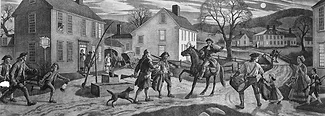
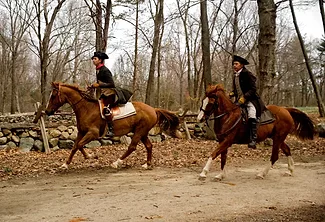
“Alerted by signal lanterns, express riders Paul Revere and William Dawes eluded British patrols and spurred their horses toward Lexington along separate routes to warn Hancock and Adams.”1
“When Revere and fellow patriot William Dawes saw two lights shine, they set off on horseback. Using two different routes out of Boston, they sounded the alert.”2
Busted:
Neither Paul Revere nor William Dawes received news of the Regulars’ advance by signal lanterns. In his classic “Paul Revere’s Ride,” published in 1861, Henry Wadsworth Longfellow exercised considerable poetic license with his legendary “One if by land, two if by sea” drama.
Awkward family gatherings have always existed. And if you were Concord resident Phebe Bliss Emerson, you might find yourself in the middle of one fairly often.
Born in 1741, Phebe was the second child of the Reverend Daniel Bliss. Her family lived in Concord, MA, where Rev. Bliss was the pastor of the Congregational Church from 1738-1764. Rev. Bliss’ fire and brimstone sermons left his parishioners quaking, crying, and praying for salvation.
Like his father, Rev. Bliss’ oldest son, Daniel, was a driven man, passionate about his beliefs and work. Daniel graduated from Harvard College in 1760 and became a lawyer. Upon passing the bar, Daniel took an oath swearing allegiance to the English monarch and the laws of England and her colonies. Daniel took the oath seriously; in his mind, to disobey would be treasonous.
John Adams once stated that “the Revolution was in the minds and hearts of the people” long before the start of the Revolutionary War. Years before British soldiers fired on the townspeople in the first battle of the war, Lexington was fighting with economics rather than weapons.
In 1774, a war between England and Massachusetts Bay Colony appeared inevitable. In preparation, Massachusetts militiamen relied upon muskets obtained from various sources: inheritance, the French and Indian War, the Siege of Louisbourg, and commercial markets.
The result was a variety of weapons of different caliber, origins, and values.
Thus, as Massachusetts soldiers marched off to war on April 19, 1775, it would not have been uncommon within the same militia company to see hunting guns, English muskets, Dutch muskets, American-made muskets (with parts from several sources), and French muskets.
In the fall of 1774, only months from the confrontation at the North Bridge, the Town of Concord was a thriving farming community and a regional trading hub accessible to Boston via two roads and with a population of nearly 1,500 inhabitants. The Town had grown gradually since its incorporation in 1635. Townspeople actively engaged in Town government and established businesses, schools, and churches to support the needs of its growing population. The inhabitants regularly squabbled over factional conflicts, but the community was harmonious in many respects.
As hostilities grew between Massachusetts and the English government in the 1770s, popular opinion was divided. Concord’s “Patriot preacher,” Rev. William Emerson, spoke out for liberty and served as chaplain for Concord’s minutemen. Meanwhile, his brother-in-law, lawyer Daniel Bliss, remained loyal to the King, and would be forced to flee for his life to Canada when war erupted in 1775.
Few places in America capture the spirit and legacy of a nation quite like Minute Man National Historical Park – located along the “Battle Road” corridor of Concord, Lincoln, and Lexington, Massachusetts. It was here that the first running battles of the American Revolution took place on April 19, 1775. Later, in the 19th century, Concord became the epicenter of a literary, philosophical, and environmental movement that endures today. Revolutions—whether on the battlefield or in the mind—demand vision, dedication, and sacrifice. The same is true for preserving the rich history to be found in these remarkable places.
When did the American Revolution begin? At the North Bridge on April 19, 1775, with “the shot heard round the world?” In Philadelphia on July 4, 1776, with the Declaration of Independence? John Adams thought the Revolution was over by the time the first guns were fired. It “was effected in the minds and hearts of the people.”
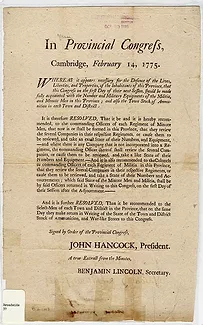
Arguably, that crucial turning-point occurred in Concord two hundred fifty years ago, when on October 11, 1774, delegates from all over Massachusetts, roughly 243 representatives from close to 200 towns, including the District of Maine, gathered in the Congregational meetinghouse (now First Parish) to deal with “the dangerous and alarming situation of public affairs” touched off by Britain’s harsh reaction to the Boston Tea Party.