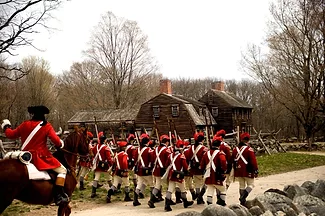
Grab your shovel and a rope, we’re going to go dig up two bodies. It won’t take long; we just need their heads. We’ll start by making our way down the Battle Road from Concord Center towards the neighboring town of Lincoln, retracing the frantic footsteps of King George’s men as they fled back to Boston on April 19th, 1775. The unexpected battle at the North Bridge still ringing in their ears, the British troops and colonists were engaged in an 18-mile battle back to Boston, sometimes collectively referred to as “The Battle of Concord.” Along the road in Lincoln, near Hartwell’s Tavern, a colonist’s musket ball slammed into the head of a British solider. Legend says that, on impact, the soldier’s body levitated high into the air before crashing dead to the ground. Around him, four more British soldiers were struck down, blood seeping through their blood red jackets into the dirt of centuries now below our feet.
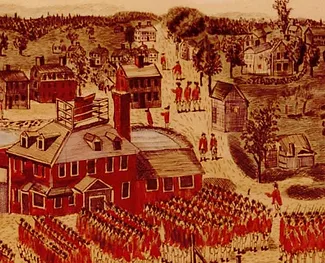
Imagine regiments of heavily armed men marching past your front door with grim determination—almost 800 of them, half the population of Concord in 1775. That was the scene that greeted the residents of the town on the morning of April 19th of that year.
If you weren’t one of the well-trained Minutemen loading your musket at the North Bridge, what was it like to be in Concord on the morning of that historic day?
There are places where you can stand for a moment between worlds. Concord Center’s Main Street is one of them. Over it, on April 19th, 1775, British officer Major John Pitcairn crossed from a world securely under English sovereignty and into one at war, fast on its way to American Independence.
If he had lived in the eighteenth century, Henry Cooke would have been called a Master Tailor. Today we call him a historical costumer, but his tailoring is no less masterful. In an era when all clothing was hand- made, proper fit was important. Achieving the right fit and the right look means understanding the way clothing was constructed. Cooke has made a livelihood out of studying original garments, finding the best materials, and mastering the techniques of measurement, cutting and construction that make reproduction clothing look like the real thing; if you’ve been to a museum, a site with historical interpretation, or a reenactment, you may have seen his work or at least seen his influence. We spoke with him about his remarkable profession.
Have you ever tried to quickly clean up the house before last minute guests come over? Heart pounding down the seconds until their obnoxiously presumptuous fists knock on the door, you do a little frantic shoving, maybe commit a little bit of treason, and hope the house looks presentable.
April 19th, 1775, 3 AM:65-year-old farmer, Massachusetts Provincial Congress member, and local militia commander Colonel James Barrett lay sleeping next to his wife Rebecca in their farmhouse two miles outside of Concord Center. The fields around their home and nearby mill were quiet in the darkness - and full of artillery and stores needed to support a Continental Army in the making.
The holiday season is here; time for awkward family gatherings! And if you were Concord resident Phebe Bliss Emerson, you might find yourself in the middle of one.
Born in 1741, Phebe was the second child of the Reverend Daniel Bliss. Her family lived in Concord, MA, where Rev. Bliss was the pastor of the Congregational Church from 1738-1764. Rev. Bliss’ fire and brimstone sermons left his parishioners quaking, crying, and praying for salvation.
“A horse! A horse! My kingdom for a horse!” Thus cried Shakespeare’s King Richard the III during the Battle of Bosworth as his horse was cut out from under him during England’s War of the Roses for control of the English throne. No horse came for Richard, and his kingdom was lost to Henry Tudor (Henry VII). But 290 years later, a horse did materialize in the darkness, galloped towards Concord, Massachusetts, and once again the power of the English throne was transformed.
What does a life of freedom and fortune mean to you? And what would you do to attain it?
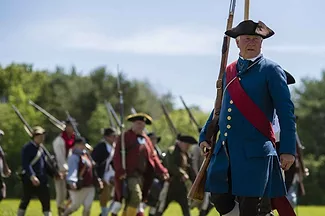
To find that life, two men from different backgrounds joined the British Army, one as a foot soldier, the other as a commissioned officer. While their upbringings and choices differed, their lives crossed one fiery day in Concord, Massachusetts.