
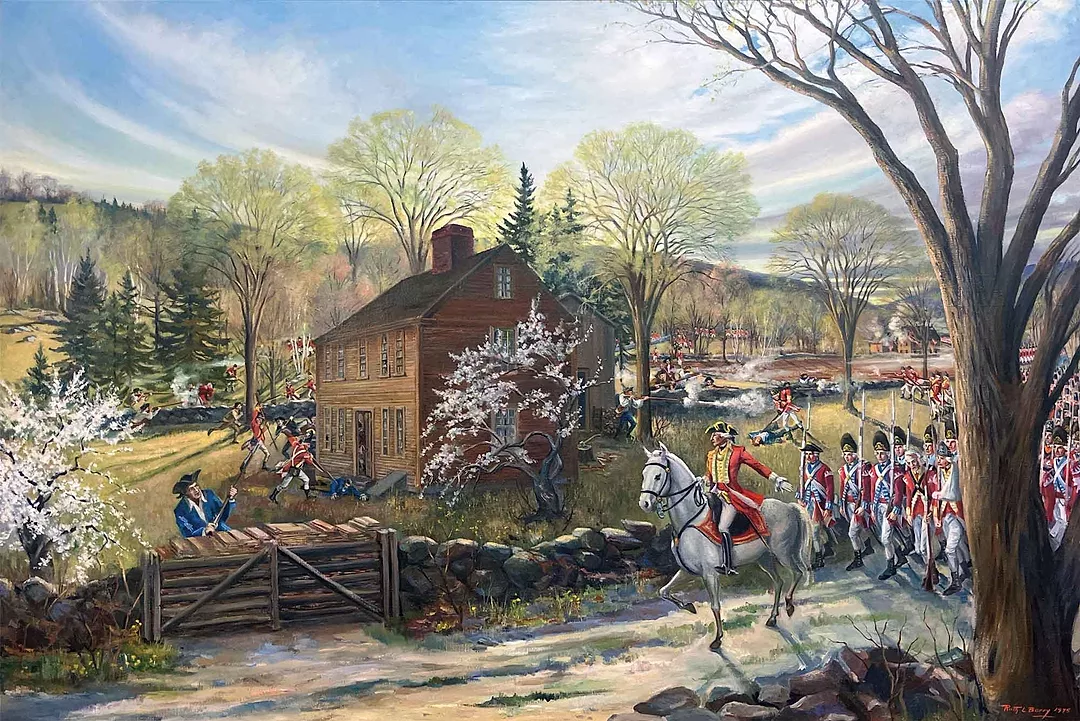
While Lexington is remembered for the first shot fired and Concord for the famous “Shot Heard ‘Round the World,” Menotomy (present-day Arlington) holds significance as the site where the majority of the fighting occurred.
As the British Regulars retreated from Lexington back toward Boston, they passed through the village of Menotomy, facing fierce resistance from the Provincial forces of surrounding towns. Of the approximately 73 British Regulars and 49 Provincials killed on April 19, 1775, 40 Regulars and 25 Provincials lost their lives along the 1.5-mile stretch between the Foot of the Rocks and Cooper’s Tavern, which is now Arlington’s city center. This village witnessed the largest engagements of the day, with many families caught in the turmoil of battle right in their own homes.
These are three of their stories.
David Lamson
David Lamson, a biracial veteran of the French and Indian War, was born in Cambridge, MA, in the mid-18th century. By 1775, Lamson had settled in Menotomy and gained local fame for his role during the war.
According to a story reportedly told by Lamson himself, Lord Percy’s reinforcements were delayed at Brighton Bridge after the planks had been removed by the Committee of Safety. When a convoy of provisions and supplies, guarded by a detachment of British Regulars, arrived behind the main force heading toward Lexington, they encountered difficulties crossing the bridge. The delay caused by the heavy wagons and the time it took to make the bridge passable led to the convoy becoming separated from the main body, leaving it vulnerable.
After an alarm rider from Cambridge alerted the locals, several men who were from the ‘exempt’ or ‘alarm’ list (meaning they were not considered fit for the standing militia or minute companies) met at Cooper’s Tavern to plan how to capture it.
Among them was David Lamson, whose prior military service and reputation for bravery made him a natural choice to take charge. It was quickly agreed that Lamson would assume the role of their commanding officer.
The group then positioned themselves behind a stone wall on the north side of the main road, across the street from near the First Parish Meeting House. As the convoy approached, Lamson ordered his men to rise and take aim. He commanded the convoy to surrender, but the drivers urged their horses forward. Lamson’s men fired, killing the driver and several horses and reportedly wounding two Regulars. In a panic, the other drivers and guards abandoned their wagons and fled toward Spy Pond, discarding their weapons.1
Lamson went on to serve in the Continental Army, participating in battles such as Bunker Hill and Saratoga. He was discharged on November 29, 1777.2
Samuel Whittemore
Samuel Whittemore is internationally recognized for his courageous role during the Battle of Menotomy. Reported as the oldest combatant of the Revolutionary War, he became an inspiring figure, bravely fighting at the age of approximately 80 during the Battle of Menotomy.
In his youth, Whittemore served with a royal regiment known as the King’s Dragoons, where he attained the rank of captain. His military service laid the foundation for his public service, leading him to later secure elected positions in Cambridge, MA. Eventually, he became the deputy sheriff of Middlesex County, where he took his first stand for liberty.
During the conflict, Whittemore reportedly stationed himself behind a stone wall in the town center as the British Regulars retreated from Lexington to Boston. It is believed that after loading his gun, he heard the wall rattle and saw approximately five soldiers approaching. Whittemore fired, hitting one of them, and then quickly drew his pistol to aim at another. Just as he fired again, he was struck by a return shot.
The enraged soldiers quickly advanced and managed to overwhelm him. They reportedly shot him in the cheek with a musket, stabbed him with bayonets, and left him for dead.
After the British moved deeper into Menotomy, locals carried Whittemore to Cooper’s Tavern, where Dr. Tufts of Medford tended to his injuries.3
Remarkably, Whittemore survived for another 18 years after these life-threatening wounds. He lived long enough to witness the birth of a new and independent nation.
In 1991, Whittemore Park in Arlington Center was named in his honor, and a granite marker commemorating him, originally made in 1877, was relocated there. Today, we celebrate “Samuel Whittemore Day” on February 2.
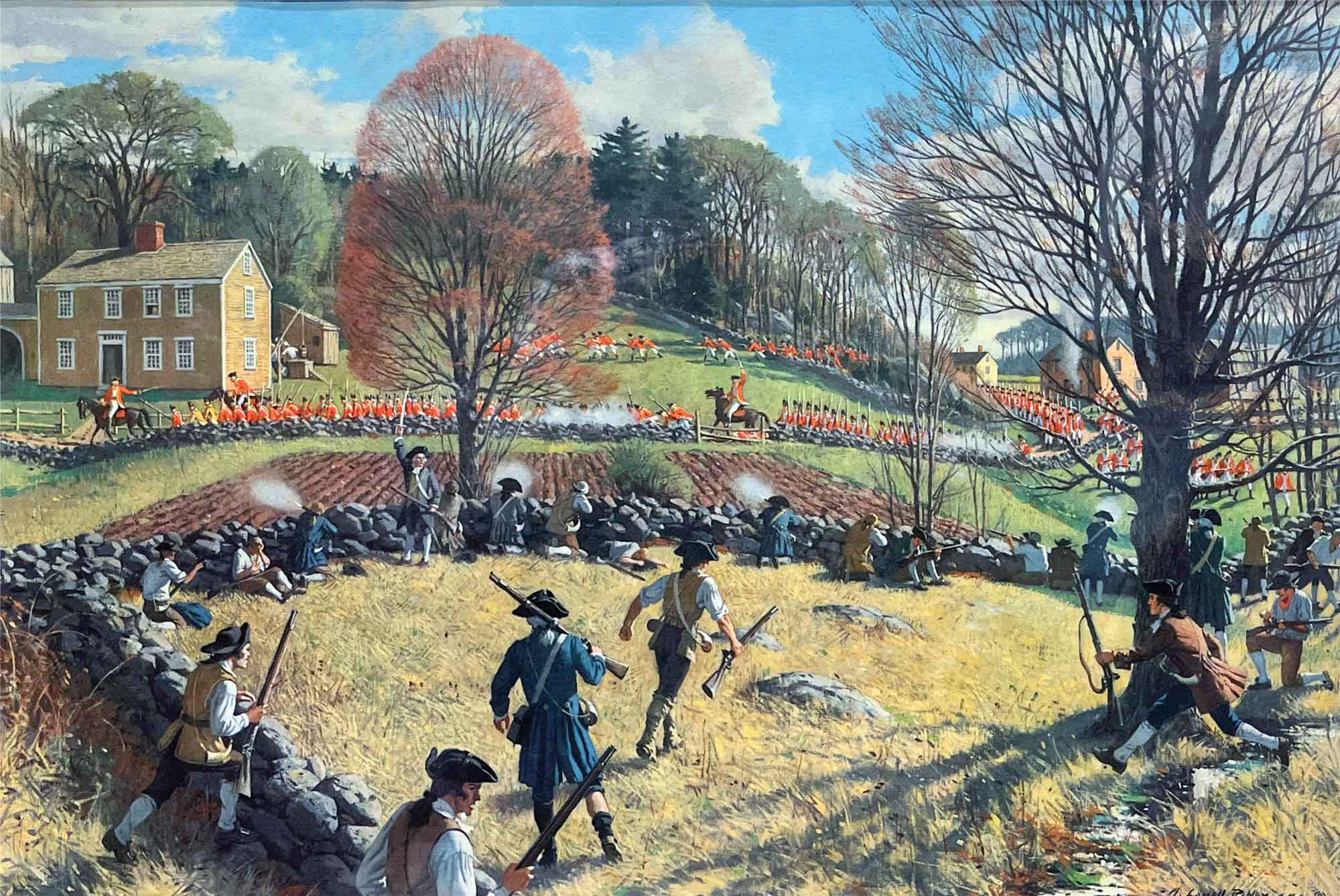
Aiden Lasell Ripley (1896-1969), Retreat from Lexington at the Foot of the Rocks.
| Courtesy of Arlington Historical Society Collections
Hannah Hall Adams
Hannah Hall, born in Cambridge in 1731, married Deacon Joseph Adams of Menotomy, a man known in the community for his fervent patriotism. Just days before the battle, Hannah gave birth to their daughter, Anna, who would later become one of the youngest witnesses to the battle at only ten days old.
As the British Regulars, retreating from Lexington under the command of General Hugh Percy, entered the village of Menotomy, they were ordered to search the homes along the main road (now Massachusetts Avenue) for Provincials who might be firing at their column. Without consent, they stormed into several residences, including the home of Joseph and Hannah Adams.
Fearing for his life, Joseph believed the soldiers would spare women and children, so he fled the house and sought refuge at Rev. Samuel Cooke’s nearby home, leaving Hannah and their children behind.
Hannah later recounted these harrowing events in a deposition. According to her testimony, several British soldiers and officers burst through her door, with three entering the room where she lay bedridden, recovering from her recent childbirth. Her five other children were hidden beneath the bed.
One of the soldiers, with a bayonet fixed, approached Hannah, aiming his musket directly at her. An officer in the room called out, “We will not hurt the woman if she leaves the house, but we will surely burn it.”4
In an instant, Hannah rose from her bed, clutching a blanket and her 10-day-old daughter Anna, and fled to a nearby barn. Meanwhile, her children remained hidden, witnessing the soldiers looting the house and taking their parents’ silver and valuables.
In a final act of vandalism, the soldiers tore pages from the family Bible to start a fire in the middle of the room. After they departed, the children emerged from their hiding place and, in a desperate attempt to save their home, extinguished the flames. Miraculously, the fire was put out just in time, though parts of the house were severely damaged.5
To explore more stories of the Battle of Menotomy, visit the Arlington Historical Society exhibition, “Untold Stories: The Battle of Menotomy, Voices of the Overlooked, & Centennial Reflections.” ArlingtonHistorical.org.
NOTES
1 Smith, Samuel Abbot. West Cambridge: 1775. 3rd ed. Arlington: Arlington Historical Society, 1974. 42-44.
2 Douhan, Beverly. Buried Secrets of Menotomy Slaves. Arlington Historical Society, 2011.
3 Smith, West Cambridge: 1775, 27-29.
4 A Narrative, of the Excursion and Ravages of the King’s Troops Under the Command of General Gage, on the nineteenth of April, 1775 Printed by Isaiah Thomas, 1775. Massachusetts Historical Society.
5 Smith, West Cambridge: 1775, 34-36.