
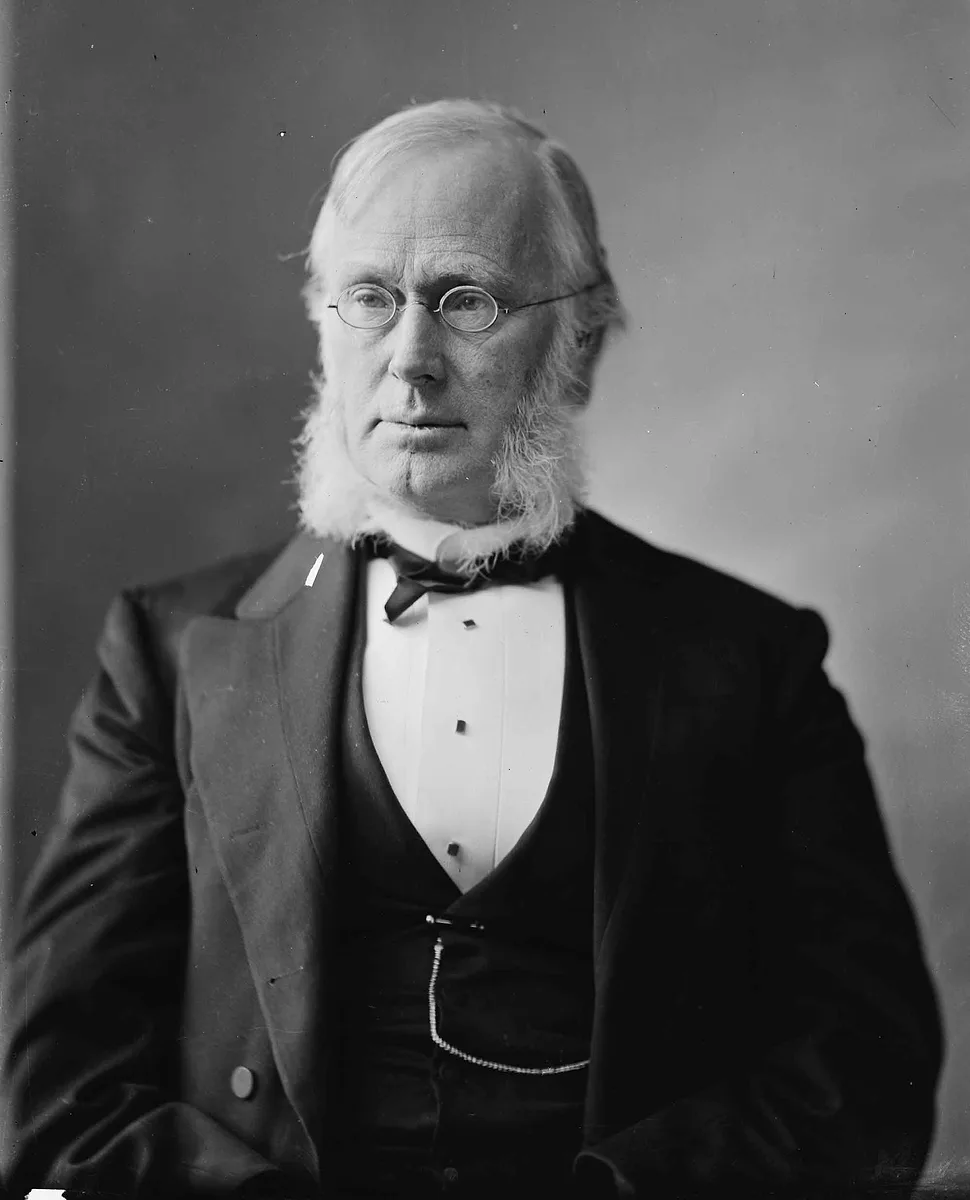
From almost the very beginning of Concord’s founding in 1635, the Hoar family played a prominent role in the town’s history. Recognized for their leadership in law, politics, and social reform, in addition to their distinguished legal and political careers, the Hoars shaped both local government and national policy. Described as “leaders to a higher and better sphere, both in social and political sense,”1 they were better known around town—and throughout Massachusetts—as the Royal Family of Concord. And none of them lived up to the family ideal of public service better than George Frisbie Hoar. This year we remember and honor him on the two hundredth anniversary of his birth.
Born in Concord, Massachusetts, on August 29, 1826, George Frisbie Hoar was the youngest of the six children of Judge Samuel and Sarah Sherman Hoar. A distinguished lawyer and congressman, Samuel was considered a pillar of the community—perhaps the pillar of the community. Sarah was the daughter of Roger Sherman, a Founding Father who signed the Declaration of Independence, the Articles of Confederation, and the U.S. Constitution.
It’s safe to say that from an early age “Frisbie” (as he was called by friends and family) was acutely aware of the Hoars’ devotion to Concord and the United States, and the family’s collective ancestry was the guiding light of his life. In 1895, he wrote, “The loftiest stimulant of the child is the example of the father.”2 Clearly, Hoar’s family acted as his moral compass.
As a young man, Hoar studied for several months at the Waltham, Massachusetts, boarding school of Reverend Samuel and Sarah Alden Bradford Ripley. Naturally, he attended Harvard College: His ancestor Leonard Hoar served as the college’s third president, while both Hoar’s father and older brother Ebenezer graduated from Harvard. Like them, Hoar studied law. He graduated in 1846, at the age of twenty, and subsequently earned his law degree from Harvard Law School in 1849. He was admitted to the bar and settled in Worcester, Massachusetts, where he practiced law for the next two decades. Initially a member of the Free Soil Party, he joined the Republican Party shortly after its founding in 1854.
Following his brother Ebenezer into politics, Hoar began a lifetime of public service when he was elected to the Massachusetts House of Representatives in 1852 and to the Massachusetts Senate in 1857. He later represented his home state on the national level as a member of the U.S. House of Representatives for four terms (1869–1877) and then as a U.S. senator for five terms until his death in 1904.
Hoar married twice, first to Mary Louisa Spurr in 1853. They had a son, future U.S. Representative Rockwood Hoar, and a daughter, Mary. Mary Louisa died in 1859, and three years later, Hoar married Ruth Ann Miller. They had a daughter, Alice, who, sadly, lived only a year.
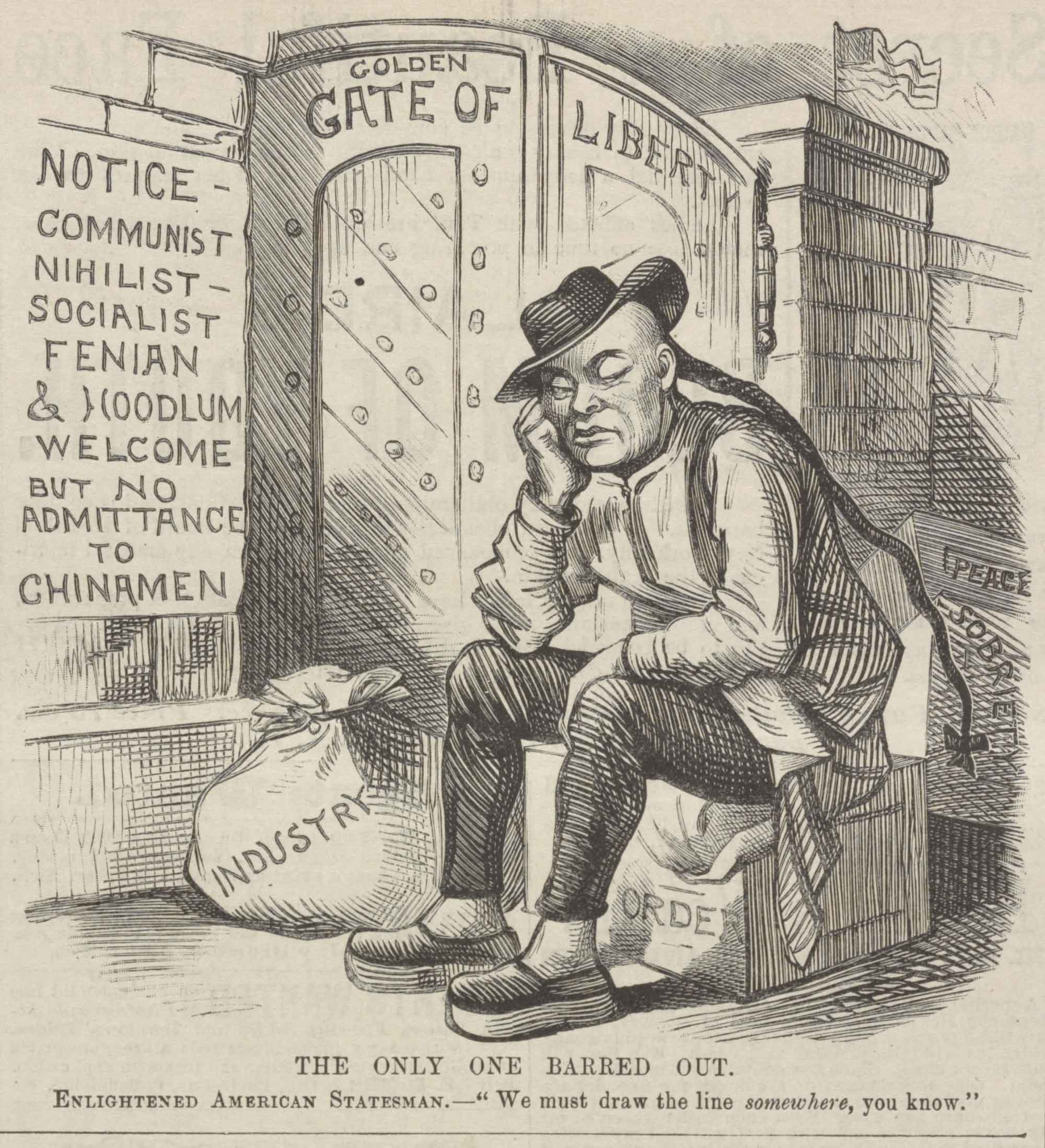
Political cartoon lampooning the Exclusion Act, Frank Leslie’s Illustrated Newspaper, vol. 54, April 1, 1882, p. 96
| Wikimedia Commons
Serving in Congress during Reconstruction, Hoar was a champion of civil rights for African Americans and Native Americans. A friend and protégé of like-minded Massachusetts Senator Charles Sumner, Hoar was asked by a dying Sumner in March 1874 to ensure the passage of his civil rights bill, which aimed to guarantee equal rights for African Americans in public accommodations such as inns and theaters and on public transportation. Sumner reportedly said, “You must take care of the civil rights bill—my bill—don’t let it fail!” Indeed, Hoar was instrumental in its passage nearly a year later in February 1875.
Also a staunch proponent of women’s suffrage, Hoar argued that women’s participation in the vote was essential for the country. He advocated for the cause in the Senate as early as 1886 and helped establish the first Senate committee on women’s suffrage. He delivered numerous addresses on the topic, including “Woman’s Right and the Public Welfare” (1869) and “Woman Suffrage Essential to the True Republic” (1873).
Although a Republican, Hoar was an outspoken opponent of American expansionism and imperialism in the late 19th and early 20th centuries. He broke with his party to vociferously oppose the annexation of Hawaii in 1898 and the colonization of the Philippines after the Spanish-American War.
Hoar also stood up for immigrants. A massive influx of Chinese immigrants arrived in the United States during the mid- to late 19th century, driven by the California Gold Rush and the construction of the Transcontinental Railroad. Approximately 300,000 Chinese immigrants entered the country between 1849 and 1882, mostly settling in California for mining, railroad, and agricultural work. The population was overwhelmingly male (a twenty-to-one ratio), with many working on five-year contracts. As numbers increased, anti-Chinese sentiment grew among white workers, leading to violence, segregation, and state-level taxes on the immigrants.
In 1882, Congress passed the Chinese Exclusion Act and President Chester A. Arthur signed it into law. Passed on the xenophobic premise that the influx of Chinese into the United States “endangered the good order of American values and ideals,” it prohibited all Chinese laborers from immigrating to the United States and was the first instance in American history where a law prevented all members of a specific ethnic group from entering the country.
When the bill came before the Senate for a vote, Hoar spoke out against “the old race prejudice” that fueled the bill, calling the Exclusion Act “nothing less than the legalization of racial discrimination.” He would be the only senator to vote against the bill. It was, perhaps, his finest moment as a legislator.
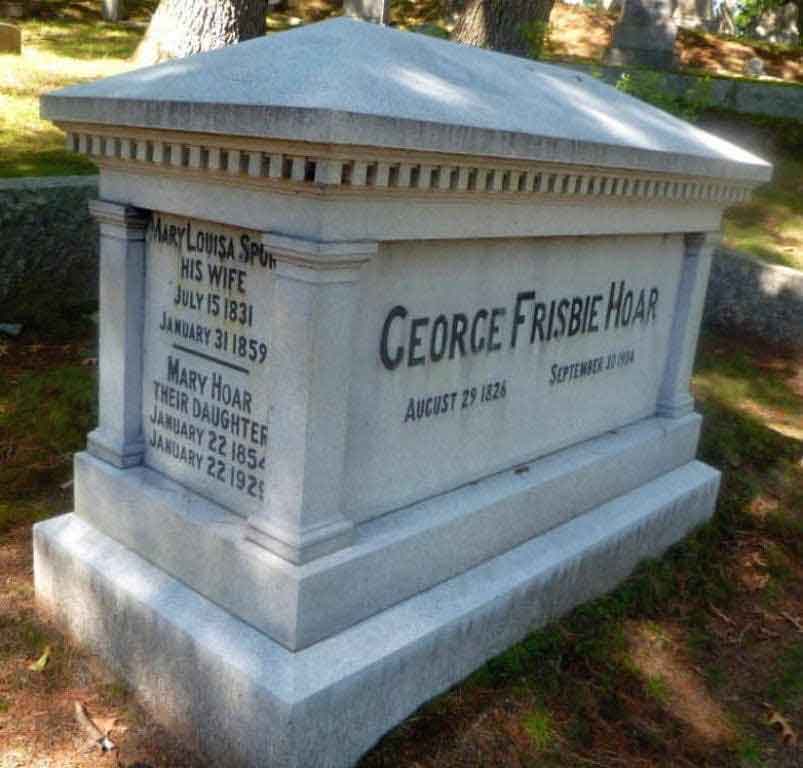
Grave of George Frisbie Hoar in Sleepy Hollow
| ©Richard SmithHoar was a man of extraordinary intellect who considered education crucial for personal improvement and social advancement. In 1865, he helped found the Worcester County Free Institute of Industrial Science (now the Worcester Polytechnic Institute) to promote industrial education. He served as an overseer for Harvard College and as a trustee of multiple institutions, including Clark University and the Peabody Museum of Archaeology and Ethnology. As if that weren’t enough, he was a regent of the Smithsonian Institution and president of the American Antiquarian Society in Worcester. He saw all of these institutions as vital for preserving the past while developing an American intelligentsia for the future.
After a lifetime of service, George Frisbie Hoar died on September 30, 1904, at the age of seventy-eight. Four years later, a memorial statue was commissioned and dedicated to him in front of Worcester City Hall. Created by Daniel Chester French, the large-scale bronze depicts a seated Hoar holding a text. The pedestal below reads:
PURITAN AND PATRIOT BY INHERITANCE, UNSULLIED IN CHARACTER
LOVER OF LIBERTY, CHAMPION OF THE OPPRESSED
HIS LIFE EMBODIED THE TRADITION OF MASSACHUSETTS
AND OF THE FOUNDERS OF THE REPUBLIC
HIS HIGH IDEALS, ZEAL FOR LEARNING, AND CONSTRUCTIVE
STATESMANSHIP MADE IMPERISHABLE CONTRIBUTIONS
TO A GREAT PERIOD OF AMERICAN HISTORY
THIS STATUE IS RAISED
BY GIFTS FROM THIRTY THOUSAND OF HIS TOWNSFOLK
THAT THE PEOPLE FOR ALL TIME MAY BE INSPIRED BY
THE MEMORY
OF HIS PERSONAL VIRTUE AND PUBLIC SERVICE
The Hoar family’s leadership in local and national reform earned them the title Conscience of the Community, and George Frisbie Hoar exemplified this stalwart commitment to public service. While Thoreau, Emerson, Hawthorne, and the Alcotts defined Concord’s literary soul, Hoar personified its moral backbone. His enduring commitment to civil rights established a legacy of social progressivism for generations to come.
NOTES: 1. Ellery Bicknell Crane, ed., Historic Homes and Institutions and Genealogical and Personal Memoirs of Worcester County, Massachusetts (Lewis Publishing Co., 1907) 2. George Frisbie Hoar, “Popular Discontent with Representative Government,” inaugural address read at the American Historical Association annual meeting, New York, NY, December 27, 1895.