
Imagine admiring an author while you are growing up and then ending up in the same stratosphere of success as them. That is what happened to Louisa May Alcott, who was described by contemporaries as an ardent and enthusiastic admirer of Charles Dickens—a writer two decades her senior. Both Dickens and Alcott wrote novels, short stories, and essays; both loved the stage and pursued amateur acting; both integrated social issues into their writings; both went from using pen names to real names; and both became household names. By 1893, only Dickens’ novels were more circulated than Alcott’s in United States public libraries.
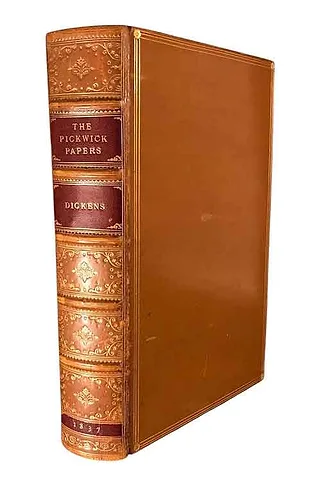
Alcott described herself as having hero worship for Dickens. She read his books growing up, and her letters and journals are peppered with allusions to Dickens characters. A favorite Dickens book for the Alcott girls was The Pickwick Papers, which was the basis for a game they played. Written when Dickens was twenty-four years old, The Pickwick Papers was his first novel and brought quick literary acclaim. The story’s title character, Samuel Pickwick, is the wealthy founder and president of the Pickwick Club, whose members travel about the English countryside and describe their encounters and discoveries.
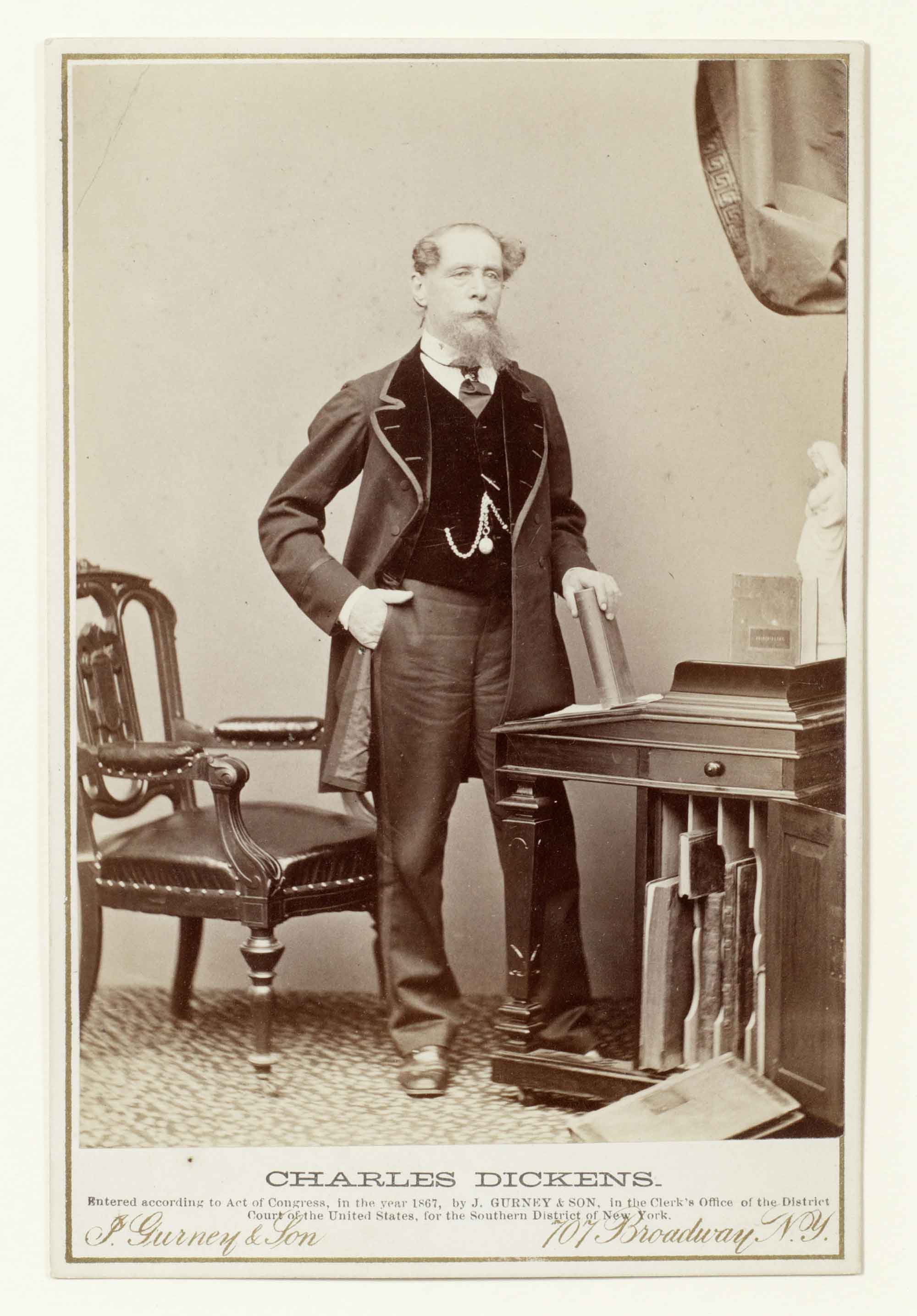
Cabinet card of Charles Dickens, 1867, Jeremiah Gurney & Son
| Wikimedia CommonsIn forming their own Pickwick Club, the Alcott sisters each assumed the identity of one of Dickens’ characters. Louisa took on the role of Augustus Snodgrass, an aspiring poet; Anna was the chairman, Pickwick; Lizzie was Tracy Tupman; and May was Nathaniel Winkle. Louisa and her sisters made Pickwick Club badges and published a newspaper to which they all submitted poems, stories, reports, recipes, and advice columns under their assumed Dickensian names.
In one issue, Anna wrote a piece about the importance of keeping the fingernails clean. Louisa wrote a long poem to her cat, “To Pat Paws,” beginning, “Oh my kitty Oh my darling, purring softly on my knee, while your sleepy little eyes dear, look so fondly up at me.” Lizzie contributed an essay on botany, and May wrote a report titled “A Trip to Nahant.”
Fans of Little Women may recognize this version of the Pickwick Club as Alcott reprised it for the March sisters, writing in Little Women, “As spring came on, a new set of amusements became the fashion . . . One of these was the ‘P.C.,’ for as secret societies were the fashion, it was thought proper to have one, and as all the girls admired Dickens, they called themselves the Pickwick Club.” The March sisters had white badges with a big “P.C.” in different colors on each and produced a weekly newspaper called The Pickwick Portfolio. The example of The Pickwick Portfolio that Alcott included in Little Women contained entries that were largely from or based on entries in the real papers published by the Alcotts.

Sairey Gamp, 1889, by Kyd (Joseph Claxqyton Clarke)
| Wikimedia CommonsFor both the Alcott and March sisters, childhood activities also included producing family theatricals. In real life, this included inspirations from Dickens’ Martin Chuzzlewitt, with young Louisa performing as Sairey Gamp, one of her favorite characters, and Anna as Betsey Prig. Gamp was a role that Alcott would reprise throughout her life, including in charity performances, and when she moved to Boston in 1867, she often referred to her room as “Gamp’s Garret.”
In 1843, when Alcott was eleven, Dickens published A Christmas Carol, a project motivated by a need for funds. A Christmas Carol was a success and pirated almost immediately by Parley’s Illuminated Library. Dickens sued the publisher and won, but the company declared bankruptcy, leaving him with legal costs but no winnings. Dickens subsequently abandoned any attempt at protecting his story, and other authors rapidly produced sequels and alternate versions.
Alcott was one such author.
Her short story “A Christmas Dream, and How It Came True” begins with a “discontented-looking little girl” who exclaims, “I’m so tired of Christmas I wish there would never be another one!” The little girl’s mother chides her for being as bad as “old Scrooge,” whom her mother describes as “one of Dickens’s best people.” This tale, published in 1882 in the magazine Harper’s Young People and later included in Lulu’s Library, was not the first time Alcott had published something inspired by Dickens.
In 1856, Alcott’s poem “Little Nell,” based on a character from The Old Curiosity Shop, was published in the Boston Daily Courier, and her poem “Little Paul,” based on a character from Dombey and Son, appeared in the Saturday Evening Gazette.

Louisa May Alcott, 1870, Warren’s Portraits
| Wikimedia CommonsDickens and Alcott also shared a love of the theater. Both wrote plays and performed in amateur productions, often fundraisers. (Dickens had nearly become a professional actor when he was twenty but skipped his audition at Covent Garden.) One of Dickens’ best-known plays was The Frozen Deep, which he wrote with his friend Wilkie Collins. Originally performed in Dickens’ home, the play also saw benefit performances in theaters and a command performance for Queen Victoria, who afterward praised Dickens’ acting in her diary.
Alcott’s performances included personifications of Dickens characters. A favorite was Mrs. Gamp, an alcoholic nurse from Martin Chuzzlewit whose character Alcott had performed as a child and later donned to entertain wounded soldiers during her brief time as a Civil War nurse. Another act that brought acclaim was Mrs. Jarley’s Waxworks, in which she combined elements from several books. As described by friend and fellow abolitionist and feminist Maria Porter, Alcott’s “impersonation of Mrs. Jarley was inimitable. . . . People came from all parts of New England to see Louisa Alcott’s Mrs. Jarley, for she had for years been famous in the part whenever a deserving charity was to be helped in that way. Shouts of delight and peals of laughter greeted her original and witty descriptions of the ‘figgers’ at each performance, and it was repeated every evening for a week.”
Although Alcott never performed for Dickens, she did attend two of his public readings, which were more performances than readings as he would memorize the material and adapt the scripts for timing and dramatic purposes. In her early thirties, a few years before writing Little Women, Alcott traveled to Europe as a companion to an invalid. During her time in England, in addition to seeing Dickens read, she tracked down sites related to his books, including while on a tour led by writer and reformer Moses Coit Tyler. Alcott published an account of these excursions as “A Dickens Day” in a December 1867 edition of The Independent. (The piece was included with slight changes in Alcott’s 1873 story collection Shawl-Straps.)
Alcott saw Dickens perform a second time during his 1867 visit to the United States. However, she was dismayed by Dickens’ appearance, describing the author then in his mid-fifties as an “old dandy,” writing in a September 1867 issue of the Boston Commonwealth that Dickens’ “youth and comeliness were gone, but the foppishness remained, and the red-faced man, with false teeth, and the voice of a worn-out actor, had his scanty grey hair curled.” After learning of Dickens’ death in 1870, Alcott noted in a letter to Anna, “I shall miss my old Charlie, but he is not the idol he once was.”
While Dickens’ glow may have faded for Alcott, the transatlantic fame of the two authors did not. When May Alcott, Louisa’s younger sister, was traveling in Europe, she wrote home to share the following exchange: “In the train from Liverpool I met a pretty young English girl, and we naturally fell to talking about books. When I spoke of Dickens, and how well he was known and loved on our side of the water, my companion said, ‘You are not more familiar with English novels than we with American ones. Just now our favorite is a Miss Alcott, who writes the most charming books I ever read.’”