
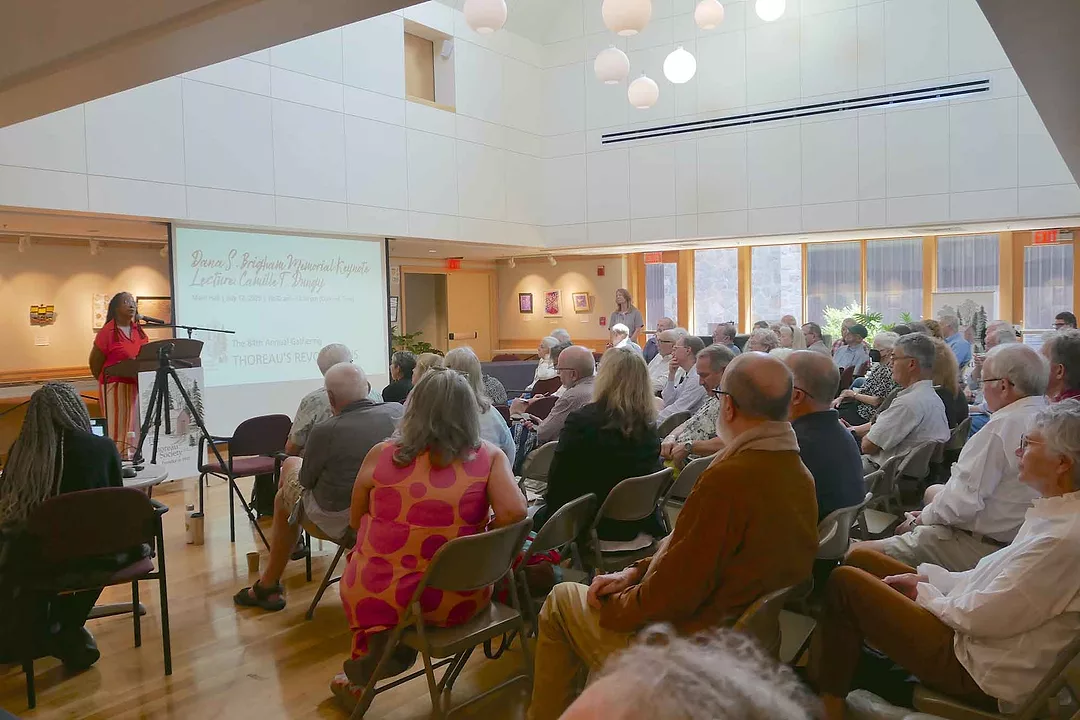
This year marks the 85th Annual Gathering of the Thoreau Society—the oldest and largest community devoted to an American author. Founded in 1941 by Walter Harding, the Society began with a simple invitation to a “Thoreau Birthday Mecca”: meet at Walden Pond, share lunch at Concord’s Colonial Inn, and talk about forming a group devoted to Henry David Thoreau.
From that modest invitation grew an annual tradition welcoming readers, scholars, writers, and nature lovers from around the world. What began as a small circle has become an international forum exploring Thoreau’s life, work, and enduring ideas. Today, as part of the Thoreau Alliance, the Society connects a rich scholarly tradition with broad public interest in how Thoreau’s writing speaks to the present.
The Annual Gathering has always reflected Thoreau’s wide-ranging curiosity, bringing together conversations on literature, environmental stewardship, social justice, and the challenge of living deliberately in a modern world. As Thoreau wrote in Walden, “Morning is when I am awake and there is a dawn in me.” For 85 years, the Gathering has kept that sense of renewal and inspiration alive.
The Gathering has also incubated major scholarship. Researchers such as Raymond Adams and J. Walter Brain presented early discoveries there, while landmark biographies—including Harding’s The Days of Henry Thoreau (1966), Robert D. Richardson Jr.’s Henry Thoreau: A Life of the Mind (1986), and Laura Dassow Walls’s Henry David Thoreau: A Life (2017)—emerged from this community.
Yet the Gathering has never belonged to scholars alone. Writers, artists, environmentalists, spiritual seekers, and curious newcomers all find a place in the conversation. Over the years, speakers have included leading voices in literature and environmental thought, among them Terry Tempest Williams, Rebecca Solnit, Ibram X. Kendi, and Jane Goodall.
For decades, Society members have also helped protect the landscapes that shaped Thoreau’s life—from championing the landmark 1957 court ruling preserving Walden Pond and forming the Thoreau Country Conservation Alliance (which inspired the Walden Woods Project) to saving Thoreau’s birthplace and advocating for the Maine Woods. By working with partners in Concord and beyond—including the Robbins House and the Penobscot Nation—the Society supports efforts to tell more complete histories, honoring the many communities that shaped Thoreau’s life.
Major milestones have also been marked at the Annual Gathering, including the discovery of Thoreau’s Walden house by Roland Robbins in 1944, the first open house of the Thoreau Institute in 1998, and the celebration of Thoreau’s Bicentennial in 2017.
What began as a single birthday gathering has grown into a multi-day exploration of ideas, landscapes, and shared curiosity. The 85th Annual Gathering will take place in Concord from July 8 to 12 (Thoreau’s birthday). This year’s theme, Living Well: Thoreau, Health, and Flourishing, asks what Thoreau’s reflections on resilience and well-being offer in an era of civic and ecological challenge.
In that first invitation in 1941, Harding wrote simply: “All who are interested in Thoreau are invited to attend.” Eighty-five years later, the invitation still stands—and each summer in Concord, a thoughtful community gathers to greet the dawn together.
For more information on the Annual Gathering visit: ThoreauSociety.org/news/annual-gathering
 The Thoreau Alliance brings Henry David Thoreau’s legacy to life by stewarding his birthplace and a vibrant community, and inspiring all to build the more just, mindful, and sustainable world that Thoreau envisioned. Through the scholarship of the Thoreau Society and programs at Thoreau Farm, the Alliance advances Thoreau’s call to notice the consequences of injustice and threats to individual freedom—both in the United States and across the globe, and invites all people to live deliberately for positive change. For more information on the Thoreau Alliance, visit ThoreauAlliance.org.
*This article made possible by the Thoreau Alliance