

Your palm is crossed by unique flowing lines that fortune tellers link to your fate. But what if that fate passed through your hand to someone else? In a poem he wrote in childhood, Nathaniel Hawthorne mused, “Oh could I raise the darken’d veil, which hides my future life from me. Could unborn ages slowly sail, before my view—and I could see my every action painted there, to cast one look I would not dare.”
If you dare, read on.
Within Concord’s Old Hill Burying Ground lie the remains of Elizabeth Barron, widow of Concord cordwainer Benjamin Barron. Better remembered by history as Elizabeth “Betty” Parris, she was one of the little girls whose accusations started the Salem witch trials in 1692. The consequences of Elizabeth’s actions lingered and inspired playwright Arthur Miller to include her as a lead character in his famed play The Crucible.
The finger-pointing by Elizabeth and others led to over 200 people being charged with witchcraft, nineteen hangings, one person tortured to death, five deaths in prison, and many lives ruined.
One of the men passing judgment on those accused of witchcraft was Judge John Hathorne, an ancestor of Concord resident and writer Nathaniel Hawthorne. The judge was nicknamed the “Hanging Judge” for his lack of mercy and refusal to accept accusers’ retractions of claims against innocent victims.
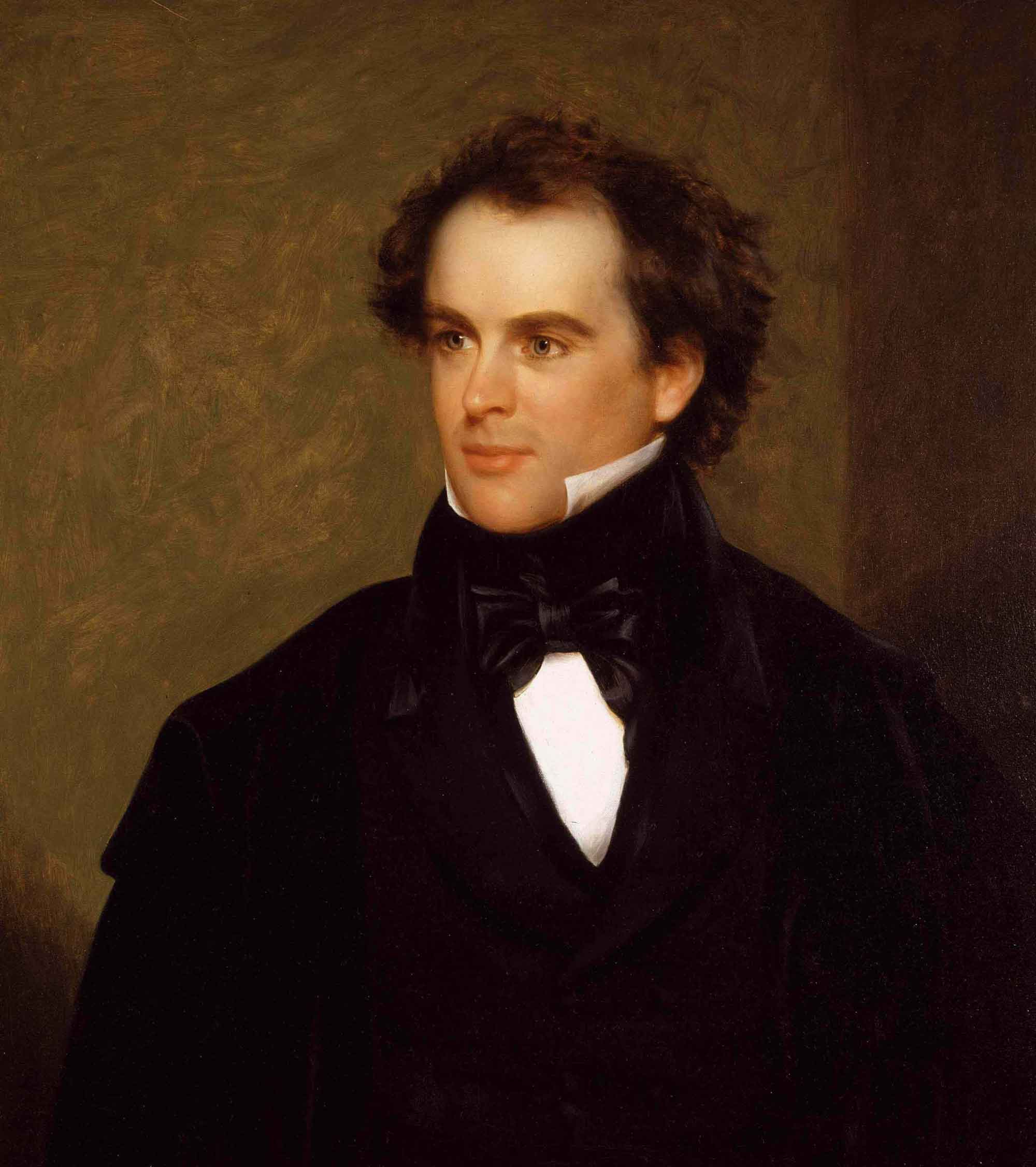
Nathaniel Hawthorne, portrait by Charles Osgood, 1841, Peabody Essex Museum
| WikimediaOn a February day in 1692, Judge Hathorne signed an arrest warrant for destitute Salem woman Sarah Good. In handwriting matching Hathorne’s signature, the warrant instructed Sarah’s arrest “for suspicion of witchcraft by her committed, and thereby much injury done to Elizabeth Parris [and others].”
Sarah Good was found guilty and sentenced with others “to be hanged by the neck until they be dead.” Described in Charles Upham’s 1867 book, Salem Witchcraft, “At the time of [Good’s] execution, trial judge Reverend Nicholas Noyes ‘urged her very strenuously to confess.’ Among other things, he told her ‘she was a witch, and that she knew she was a witch.’” To this, a passed-down tale says that Sarah Good screamed back at Noyes and all the judges whom he represented, “You’re a liar! I’m no more a witch than you are a wizard! If you take my life away, God will give you blood to drink!”
A few months later, farmer Samuel Wardwell of Andover found himself on the same gallows. A self-proclaimed palm reader and fortune teller, Wardwell confessed to knowing “he was in the snare of the devil . . . [and] foolishly led along with telling of fortunes, which sometimes come to pass.” Despite his confession, Wardwell was not spared. He was the last man to be hanged during the Salem witch trials.
The trials ended; the centuries changed. But once spoken, did Sarah Good’s curse remain? In 1717, Reverend Noyes suffered a hemorrhage and died choking on his own blood. By contrast, Judge Hathorne died peacefully, and his son Joseph lived a quiet life of a land-bound farmer.
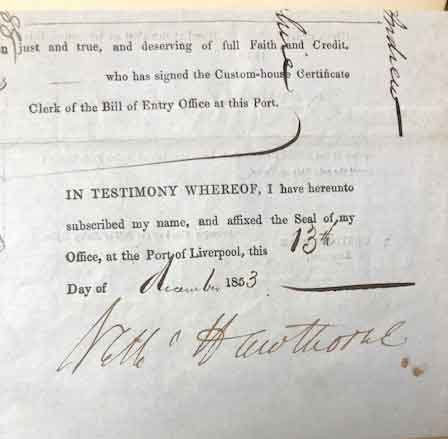
United States consular document signed by Nathaniel Hawthorne
| ©Barrow BookstorePerhaps the curse came for the Hathornes not on land but in flowing liquid, for misadventure began when Joseph’s son Daniel took to the sea as a privateer during the Revolutionary War to supplement the American Navy, which consisted of just five ships in 1775. One of those ships was captained by Nicholas Biddle, the third great-nephew of hanged fortune teller Samuel Wardwell. Both Daniel Hathorne and Nicholas Biddle sailed into legend—Hathorne shot in the head during a sea battle, and Biddle killed in action when his ship exploded.
Daniel Hathorne’s son Nathaniel followed his father into the merchant trade as a sea captain. During an 1808 trip to the East Indies, Captain Hathorne died from yellow fever, leaving behind in Salem his wife, six-year-old Elizabeth, four-year-old Nathaniel Jr., and baby Louisa.
Under the shadow of his father’s death, Nathaniel Jr. grew up acutely aware of his family’s history, the role of his second great-grandfather, John Hathorne, in the witch trials, and the rumored curse hanging over his family. After graduating from Bowdoin College, seeking to distance himself from ancestral shame, Nathaniel officially added the w to his surname, becoming Nathaniel Hawthorne. But he did not leave his family’s history completely behind. While living in Salem, Hawthorne wrote The Scarlet Letter, in which he submitted to his readers that he took Judge Hathorne’s shame upon himself and “pray[ed] that any curse incurred . . . may be now and henceforth removed.”

The Wayside
| WikimediaA year later, in 1851, Hawthorne incorporated the tale of Sarah Good’s “blood to drink” curse and Reverend Noyes choking to death on his own blood into his novel The House of the Seven Gables.
In 1852, Hawthorne, his wife, and their three children moved to Concord when he purchased the Wayside House. Hawthorne’s sister Louisa planned to visit them after a holiday in Saratoga Springs, New York. Rather than take the train as planned, however, Louisa chose to board the Henry Clay—a newfangled boat promising a luxurious and scenic trip along the Hudson River. Shortly into the journey, a fire broke out in the engine room and rapidly spread throughout the boat. While some desperate passengers leapt into the water, Louisa was trapped in the ladies’ cabin as flames and smoke consumed the ship. At the time, the fire on the Henry Clay was the worst maritime disaster in America. Two days after the July 28 disaster, The New York Times reported, “The dear sister of our friend Nathaniel Hawthorne . . . is among the lost . . . presumed drowned.”
Devastated by the death of his sister, Hawthorne focused on work, a month later finishing a campaign biography for his college classmate Franklin Pierce. When Pierce was elected president in 1853, he appointed Hawthorne to the prestigious role of U.S. consul in Liverpool, England—a role Hawthorne held from 1853 to 1857. The job included meeting ships coming into Liverpool’s port, inspecting cargos, and signing official documents detailing each ship’s name, captain, contents, and destination. The work left Hawthorne bored and frustrated, and in an August 12, 1854, diary entry, he wrote, “I am sick to death of my office—, brutal captains and brutal sailors; continual complaints of mutual wrong, which I have no power to set right.”
Hawthorne might have been “sick to death,” but that was nothing compared to what befell the ships for which he signed documents. Research for this article found consulate documents that Hawthorne signed for fourteen ships. While he likely encountered more vessels, the following recounts the fates of the fourteen.
 © istock.com/Elen11
Ship: Isaac Wright
Caught fire on the River Mersey in England and sank (1858).
Ship: Isaac Webb
Captured by Confederates during the Civil War and ransomed back to the owners. On separate journeys, multiple captains and crews died of frostbite and in storms. Fell apart at sea and sank (1880).
Ship: Harvest Queen
After it collided with the White Star Line’s Adriatic in the Irish Channel, witnesses heard a terrible “scream” as though the ship itself was in anguish. Harvest Queen disappeared in seconds; her whole crew was lost (1875).
Ship: Neptune
In heavy fog and rain, the Neptune crashed into the coast of Nova Scotia and filled with water. For three days, the crew tried to keep the boat afloat and get off the rocks, but once free, the boat smashed into more rocks and broke apart. The survivors climbed miles over slick rocks to a lighthouse, but the keeper was months past an expected resupply and had little food. By luck, they hailed a passing ship to remove the survivors (1876).
Ship: Manhattan
Disappeared en route from Liverpool to New York; all presumed lost (1863).
Ship: Yorkshire
Disappeared en route from Liverpool to New York; possible mutiny (1862).
Ship: Montezuma
Wrecked on Jones Beach, Long Island (1854).
Ship: SS Ericsson
Hawthorne signed for this ship when it was a new but slow transatlantic passenger ship. Due to its lack of speed, the ship became a mail carrier but was too slow for that as well. Eventually, the ship was retrofitted with three sails, but this new capacity helped a gale push it straight into the rocky Entrance Island in British Columbia where it wrecked (1892).
Ship: James Baines
The pride of its fleet, with a gilt interior, the James Baines was a luxurious and fast passenger and cargo clipper ship. While unloading in Liverpool, the ship caught fire and burned to the waterline. The ship’s insurance had expired three days before (1858).
Ship: Undine
Wrecked in “sunk sand” (quicksand) hiding below the ocean surface (1862).
Ship: Star of the West
Used in the Civil War to transport supplies and troops to Fort Sumter, the ship was fired upon in what some scholars deem the first shots of the Civil War. She was captured by Confederate forces, used as a Confederate hospital and to transport gold, and intentionally sunk to block the passage of Union ships during the defense of Vicksburg (1863).
Ship: Falcon
Lost in a fog off of Cape Breton, Nova Scotia (1857).
Ship: Pacific
Disappeared en route from Liverpool to New York; all 186 souls aboard presumed lost (1856). In 1861, a paper in a bottle washed up on the shore of Scotland’s Outer Hebrides reading: “On board the Pacific, from Liverpool to N. York. Ship going down. (Great) confusion on board. Icebergs around us on every side. I know I cannot escape. I write the cause of our loss, that friends may not live in suspense. The finder of this will please get it published. W. M. Graham.”
Ship: Sardinia
Wrecked in a gale on Hedgehog Island, Wisconsin (1900).
Perhaps fortunately for others, Hawthorne’s term as consul eventually ended. But his connection to ships was not quite finished. During World War II, the United States produced 2,711 Liberty ships to transport troops and supplies. Named after prominent Americans, over 2,400 of these vessels survived, but not the SS Nathaniel Hawthorne.
In November 1942, off the coast of the Isla de Margarita, the SS Nathaniel Hawthorne was struck by two German torpedoes, inverting so quickly that there was no time to deploy lifeboats. The ship’s acetylene supply exploded, and the ship was gone within a minute. Of the fifty-two souls aboard, thirty-nine were killed.
For two days, as the thirteen survivors of the SS Nathaniel Hawthorne sought to stay alive on the surface, perhaps Nathaniel Hawthorne’s prayer expressed in The Scarlet Letter hovered above them: “I pray that any curse incurred by [Hanging Judge Hathorne] … may now and henceforth be removed.” And perhaps a “Good” and higher power answered when—in their thirty-ninth hour at sea—the hands of the survivors of the SS Nathaniel Hawthorne reached up to grasp the palms of rescuers arriving on the SS Nicholas Biddle, a Liberty ship named for the third great-nephew of palm reader and fortune teller Samuel Wardwell, the last man hanged for witchcraft during the Salem witch trials on the same scaffold as Sarah Good.
“Fate, certainly, [is] a strange thing.” ~ Nathaniel Hawthorne, English Notebooks
For a list of sources, please email BarrowBookstore@gmail.com.