
Questions 1-5: You are a carefree Puritan who has embraced your predestined path and plunged happily into a new adventure by immigrating to the Massachusetts Bay Colony from England. In 1635, you join other families in settling the town of Concord.
QUESTIONS
1. You write a letter home to your oldest brother (who inherited the family estate while you got nothing, because that’s the way it goes) to share what unique fact about Concord?
A. It has a river
B.
There are already houses built and waiting for you
C. It is the first inland town in Massachusetts settled by Europeans
D. The colony is granting every settler thirty-five pounds in compensation
Click to show the answer
A. It has a river
B. There are already houses built and waiting for you
C. It is the first inland town in Massachusetts settled by Europeans
D. The colony is granting every settler thirty-five pounds in compensation
Answer:
C. Concord is the first inland town in Massachusetts settled by Europeans. (You arrive in September 1635 and will likely spend your first winter freezing in a makeshift house, and you’re certainly not being paid to be here. But you don’t need to tell your brother any of that.)
2. You’ve survived your first winter in Concord, and people are joyously welcoming the spring. However, you and other early settlers are encountering a recurring problem that must be addressed. Is it:
A. Wild animal attacks
B. Flooded planting fields
C. Frequent sickness, and the town lacks a doctor
D. Puritan women claiming “New World, new me” and wearing their skirts above their ankles
Click to show the answer
A. Wild animal attacks
B. Flooded planting fields
C. Frequent sickness, and the town lacks a doctor
D. Puritan women claiming “New World, new me” and wearing their skirts above their ankles
Answer:
B. Flooded planting fields. As detailed in Lemuel Shattuck’s A History of the Town of Concord, and in the Records of the Governor and Company of the Massachusetts Bay in New England, some of the fields in Concord “selected for cultivation, proved to be of a poor quality; and the meadows were unexpectedly-much overflowed with water…. Among other projects to make the meadows dry” colonists deepened “the channel of Concord river at the falls” to drain off excess water.
3. Now that you’ve solved the problem in question 2, you can get back to focusing on tending the fields in Concord. You need fertilizer. What fertilizers are commonly being used in Concord? Choose all that apply.
A. Ammonium nitrate
B. Dead fish
C. Manure
D. Potash
Click to show the answer
A. Ammonium nitrate
B. Dead fish
C. Manure
D. Potash
Answer:
B. Dead fish, and C. Manure. Possibly, but not likely, potash. As detailed by Washington Bureau of Chemistry Chief C.A. Browne in a 1926 article, “Historical Notes Upon the Domestic Potash Industry in Early Colonial and Later Times,” in the colonial era, potash was primarily derived from wood ashes and chiefly used in making soap, glass, pitch, tar, and other goods. Its fertilizing abilities were not recognized until a later date. Ammonium nitrate wasn’t invented until 1659.
4. While your brother in England, living on the inherited estate, might be surrounded by lavender and rose gardens, your Concord fields are now profusely fertilized for the spring and quite aromatic. You are more than happy to get away to Concord Center and join fellow townsmen at a stream that runs through the town, by the meeting house. Together, you begin creating a dam to turn the stream into a pond. What could be the main purpose of this?
A.
Creating a natural baptismal font for the nearby church
B. Creating a “dunking” site and serving as a visible warning to deter witches
C. Creating a “cloak-a-mat” to wash clothes
D. Creating a pond to power a mill
Click to show the answer
A. Creating a natural baptismal font for the nearby church
B. Creating a “dunking” site and serving as a visible warning to deter witches
C. Creating a “cloak-a-mat” to wash clothes
D. Creating a pond to power a mill
Answer:
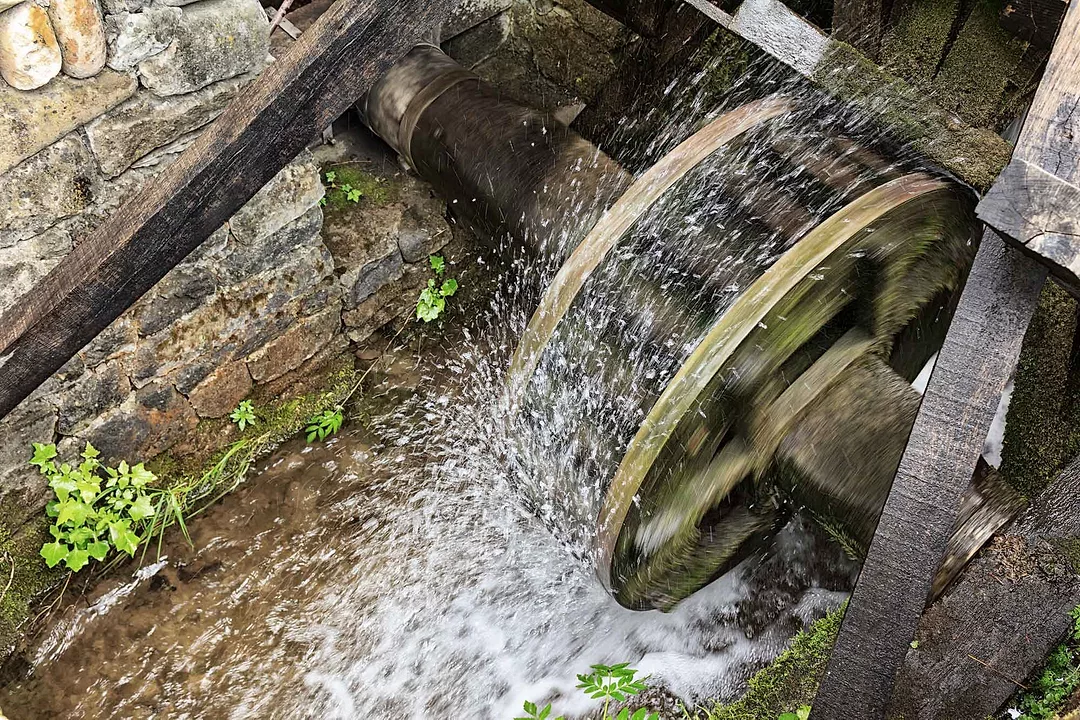
D. Creating a pond to power a mill. The pond was called “the millpond.” In the 1830s, the Concord Milldam Company bought up land in Concord Center and drained the millpond to develop the land. The mill brook still runs through Concord Center, passing unseen under a portion of Main Street.
5. Unlike those upstart settlers in Maine and New Hampshire who bury their dead on their own farms, you in Concord are proper Englishmen and follow the English custom of burying people in the churchyard. While many early Concord settlers live near the town center, your friend lives farther out near today’s Estabrook Woods. He has passed away, and you’ve been asked to help carry his coffin to the graveyard. As revealed in Concord historian Mary Fenn’s pamphlet Tales of an Old Church, which of the below might assist you in this task?
A.
A “mort stone”: large, flat stones strategically placed throughout Concord on routes to the graveyard, useful for resting a coffin and giving coffin bearers a break
B.
Oxen-musher harness: a leather and wood yoke contraption worn by four coffin bearers and bound together by leather webbing to cradle the coffin
C.
A Leicestershire shoulder strap that pads your carrying shoulder
D.
Claiming you fell in the millpond and are not available to help
Click to show the answer
A. A “mort stone”: large, flat stones strategically placed throughout Concord on routes to the graveyard, useful for resting a coffin and giving coffin bearers a break
B. Oxen-musher harness: a leather and wood yoke contraption worn by four coffin bearers and bound together by leather webbing to cradle the coffin
C. A Leicestershire shoulder strap that pads your carrying shoulder
D. Claiming you fell in the millpond and are not available to help
Answer:
A. A mort stone. According to Fenn, two mort stones could still be found in Estabrook Woods in the 1970s.
6. With a slogan of “Unite for Good,” this Concord club was founded in 1931 with a mission to “better the world through humanitarian service.” As stated on their website, club members are “local business owners and civic minded citizens who work together to support our community and people in need around the world.” You can often find them at local events, greeting the public and sharing goodwill. What is the name of this club? (Need a hint? Think: Barrett’s Mill Road, Union Turnpike, Elm Street, and Commonwealth Avenue.)
Click to show the answer
Answer:
The Rotary Club of Concord.
Hint explanation: Barrett’s Mill Road, Union Turnpike (a.k.a. Route 2), Elm Street, and Commonwealth Avenue are all roads connecting to the Concord Rotary.
7. He had three chairs in his house but no TV. Beginning in March 2026, this Concord historical figure is the focus of a PBS documentary produced by Ken Burns and Don Henley. Is he:
A. Amos Bronson Alcott
B. George Washington Dugan
C. Ralph Waldo Emerson
D. Frank Sanborn
E. Henry David Thoreau
Click to show the answer
A. Amos Bronson Alcott
B. George Washington Dugan
C. Ralph Waldo Emerson
D. Frank Sanborn
E. Henry David Thoreau
Answer:
E. Henry David Thoreau. Titled “Henry David Thoreau,” the series is directed by Erik Ewers and Christopher Loren Ewers. Thoreau is voiced by Jeff Goldblum, with narration by George Clooney and additional voiceovers by Ted Danson, Tate Donovan, and Meryl Streep.
8. Ken Burns has been busy! In addition to the above documentary, what other Concord-related documentary did he produce that aired in November 2025?
Click to show the answer
Answer:
“The American Revolution.” This six-part docuseries about the Revolutionary War included events in Concord.
9. What do Jo March and Barbie have in common?
Click to show the answer
Answer:
Greta Gerwig, who directed both the 2019 film “Little Women” and the 2023 film “Barbie.”
10. Released in 2025, “A Fight for Freedom: Honoring Patriots of Color,” is a documentary produced by the Town of Concord, Minute Man National Historical Park, and Concord’s African American History Museum. What is the name of this museum, and where is it located?
Click to show the answer
Answer:
The Robbins House. Located at 320 Monument Street, the museum may be visited in person or online. “A Fight for Freedom: Honoring Patriots of Color” is available for viewing on their website at RobbinsHouse.org
Contact Barrow Bookstore for a list of sources. Barrowbookstore@gmail.com.
————————————————————————
For more than 50 years, Barrow Bookstore has been a favorite of residents and visitors alike, specializing in Concord authors and history, children’s books and literature. The shop also provides a wide array of gently read and rare titles ranging from paperbacks to first editions and original manuscripts. Staff members have all worked as tour guides and reenactors in Concord and are happy to share their knowledge about the town and its history. Discover more at barrowbookstore.com.