If a stranger approached you at the British Museum in London or the Louvre in Paris, asked your nationality, and on hearing “American,” burst out in an enthusiastic rendition of “The Star-Spangled Banner,” would you be wary or alarmed, curious or pleased? Concord’s John Muresianu has been offering such spontaneous musical greetings to Concord’s international visitors for sixteen years, to near-universal acclaim—including a recent flattering profile on National Public Radio’s Weekend Edition. Instead of irritation, his impromptu serenades of the most beloved songs in the tourists’ homelands prompt broad smiles and effusive thanks. “You’ve made my day,” one visitor after another tells him. Their responses do the same for him and sustain his self-chosen calling as Concord’s unofficial greeter.
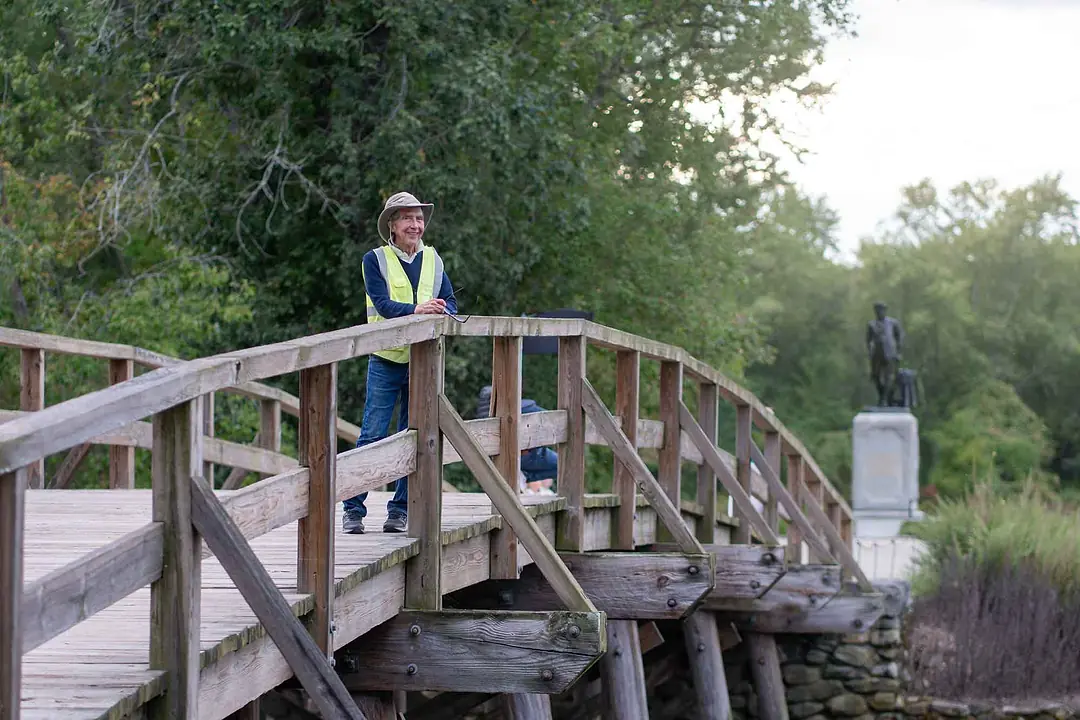
Muresianu, seventy-three, is a familiar figure on the Concord streets, trailing the same routes followed by minutemen and British regulars back in 1775. Outfitted in a shiny yellow vest (as a safety precaution to alert oncoming traffic) and sporting a broad-brimmed Tilley hat (“hand-crafted with Canadian persnicketiness,” the label states), the slim, medium-height (five foot eight) resident of Barretts Mill Road appears dressed for a safari, on the lookout not for prey but for fellow souls with whom to form a musical—and human—connection.
Muresianu began his daily walks fifteen years ago with no sense of mission. He was acting on doctor’s orders. At age fifty-five, he had been diagnosed with congestive heart failure, and if he wished to survive, he needed to step away from the computer screen and take a daily one-hour hike. As he made his rounds through the national park and followed a circuit around the center, he passed one person after another without ever saying hello. It seemed odd to be so alone in public. But he relished the exercise, and his mind worked better while he walked. So why not break the silence?
As a boy growing up in the District of Columbia, Muresianu was “pathologically shy.” He had also been rejected for a spot in his church choir. However, one day, he impulsively greeted a park visitor and asked where she was from. Getting France for an answer, he burst into song, bellowing out “La Marseillaise,” the French national anthem, with all the passion of the exiles at Rick’s Café in the movie Casablanca. As he performed, he was “sweating buckets” in fear that he would be reported to the park police as a nuisance—or worse. He had no cause for concern. “You’ve made my day,” the French visitor enthused in the first of many such compliments over the years.
That same day, he tried again with a Mexican visitor, performing the popular folk song “Cielito Lindo” (“Pretty Little Darling”) and then with German tourists, for whom he sang Beethoven’s “Ode to Joy.” Experiencing a huge “dopamine rush” from each encounter, Muresianu was hooked. Fifteen years later, he estimates that he has interacted with some 30,000 people over the years (20 people a day x 100 days x 15 years). By now, he has learned the most popular songs in forty-six languages, including eight from Asia, five from Africa, and four from the Middle East. Every song learned and sung makes a new friend.
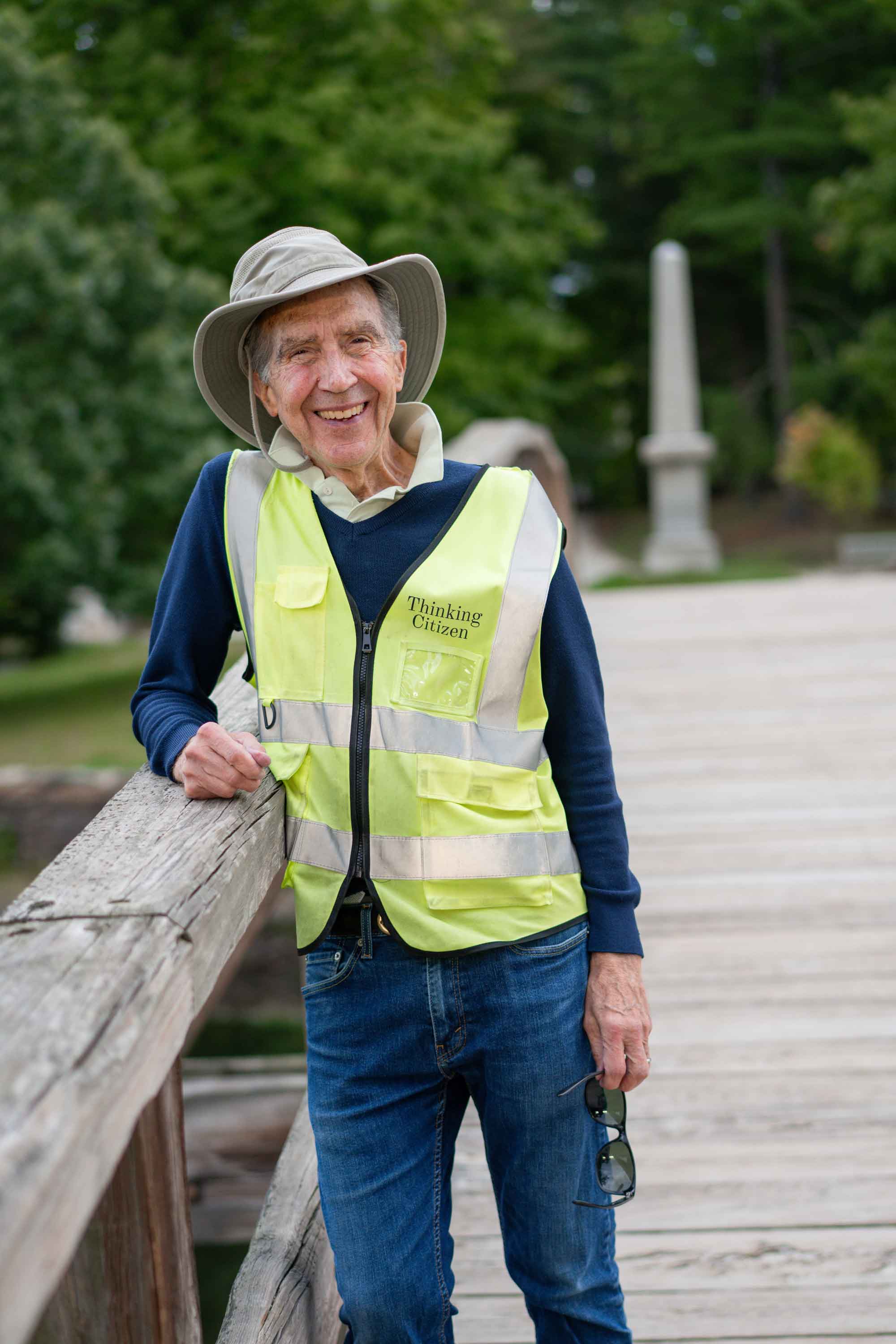
John Muresianu, Concord’s unofficial singing greeter
| © Chiha PortraitsWhy such interest in foreign visitors? Surely, one reason is that he is the son of immigrants—his father from Romania after World War II, his mother the daughter of a Norwegian ship captain and maternal granddaughter of Jewish immigrants from Vienna in the 1890s. He also has music in his genes. The Muresianu name is well-known in his father’s homeland. One forebear, Iacob Muresianu (1857–1917), was a noted pianist and composer who sought to create a Romanian national style out of the authentic folk traditions of different regions. Another ancestor, the poet Andrei Muresianu (1816–63), composed the lyrics to what would become the Romanian national anthem after the fall of Communism in 1990.
Despite this remarkable lineage, Muresianu was drawn to history, not music, in school. Outside the classroom, he threw himself into the radical, anti-war politics of the era and joined in protest songs with gusto—a foretaste of his future avocation. As a student at Harvard College (class of 1974), he focused on French and Spanish history and then went on to earn a PhD from Harvard in the History of American Civilization, with a dissertation on American thinkers who had failed miserably to comprehend and communicate the political disaster unfolding in Europe during the 1930s. Here lie the intellectual origins of his commitment to breaking down the barriers to communication among different peoples and forging emotional bonds through song.
Muresianu’s career in academe was short-lived. After two years as an assistant professor of history at Knox College in Galesburg, Illinois, he returned to the Boston area, retrained in the field of banking and finance, and became a portfolio manager and analyst at Fidelity Investments in Boston. The new career called on similar intellectual capacities to those he honed doing history, and he thrived at Fidelity—so much so that he was hailed as a “star” in the financial community. When he decided to go out on his own, his departure was big news. Relocating to Concord, he launched a hedge fund that lasted a little more than two years. A second try succeeded for more than a decade, until he retired in 2022. But Muresianu never gave up on his passion for ideas, his love of history, and his pursuit of community.
Recently, on a beautiful summer day in late August, with clear sky and mild temperature, Muresianu set out to win new friends through music. Trailed by this reporter, he greeted visitors to Minute Man National Historical Park with practiced ease. “Hello, folks. Where you from?” he asked without a hint of his youthful self-consciousness. The welcome was warm, the approach disarming. Each encounter, friendly and seemingly unique, followed a similar pattern. After learning visitors’ origins, Muresianu responded in song or took requests. Over a couple of hours, he sang anthems and folk songs in Armenian, Chinese, Japanese, Sanskrit, and Ukrainian, to the delight of all. To hear her national song, said one woman from Ukraine, “gives me goose bumps.” Rarely is Muresianu stumped. But on this day, a young man from Mongolia posed an insuperable challenge. At Muresianu’s request, he put on a display of his homeland’s distinctive sounds, vibrating with low and high pitches at the same time. As Concord’s unofficial greeter moved through the park, a model United Nations took shape.
Not all songs are international. At Daniel Chester French’s The Minute Man statue, Muresianu directed attention to Emerson’s verse inscribed in the stone base (“Concord Hymn”). Did you know it was meant to be sung? Muresianu demonstrated with the first stanza (“By the rude bridge”). Two listeners immediately recognized the tune. “That’s the doxology”—a hymn that had been the Puritans’ favorite. The former historian was supplementing the park rangers. Soon, a family from Utah was rapt by Muresianu’s version of the Mormon hymn, “I Am a Child of God.” As a dozen or so listeners burst into applause, they made Muresianu’s day.
It’s not all about the music. The former professor not only builds community as he goes but also promotes an educational agenda. A onetime candidate for the Concord School Committee—he lost the election but “loved” meeting people in the campaign—he posts daily commentaries about “the joys of the liberal arts” for Adams House at Harvard and about the knowledge and habits of mind required to be a “Thinking Citizen.” “I will tell you the greatest sentence ever written in the English language,” he challenges visitors, already made receptive by his songs. “Inhale with gratitude,” it begins, “exhale with kindness. Repeat.” Can you do better? (Unless prompted, Muresianu does not disclose his authorship.)
If that’s not enough, he offers other guides to living, loving, and thinking. Gratitude, he likes to say, quoting Cicero, is “the parent of all virtues.” He adds that “we humans are programmed to get the greatest joy from bringing joy to others.” He has developed an analytical model for construing ideas and information that he calls “the Orion principle.” Based on the constellation, it is a tool of thought he deems—hyperbolically—worthy of a Nobel Prize. Muresianu is also a preacher of the American Dream—in his words, “a world where every child can reach their full potential for joy, productivity, and responsibility.”
In effect, Concord’s singing greeter is also a familiar figure in town history: a philosophical walker in the footsteps of Emerson and Thoreau, but one who seeks not solitude but connection through the songs sung round the world.