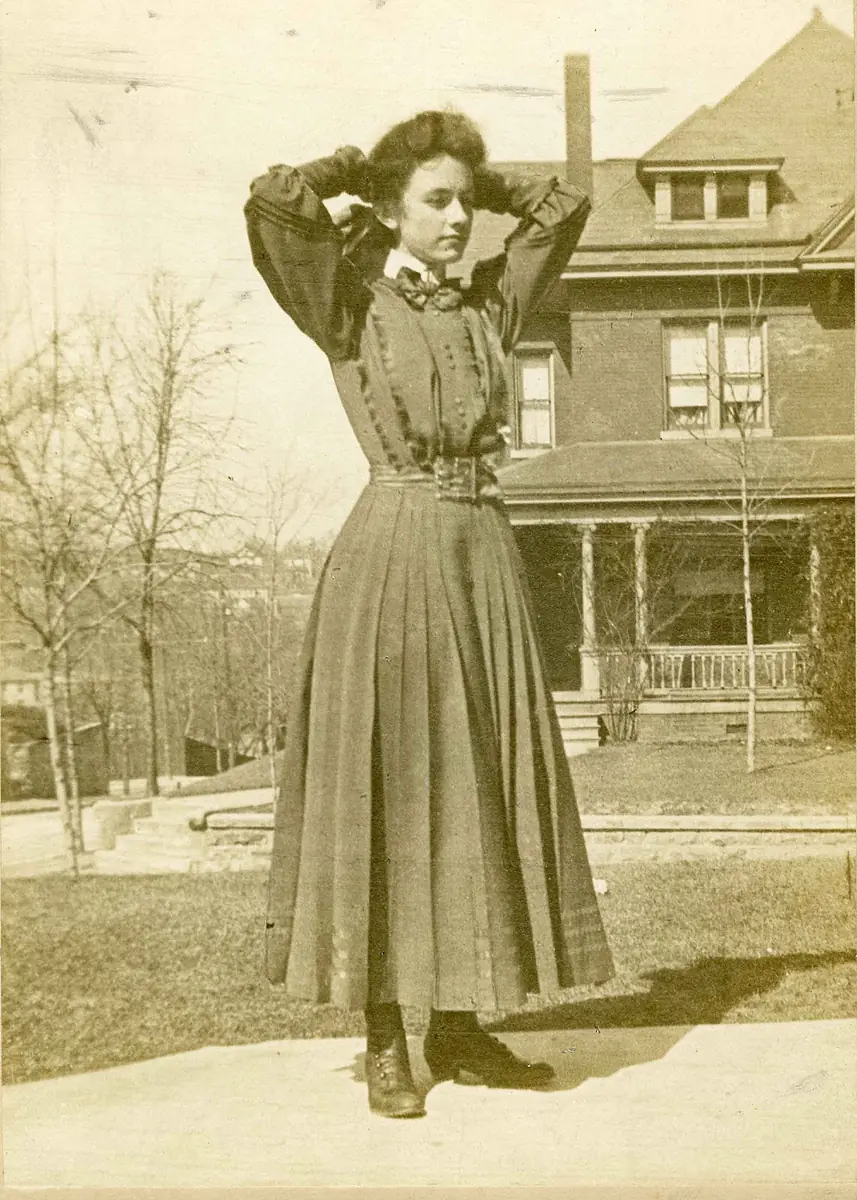
Like fruitcake, “The Little Drummer Boy” may not be everyone’s favorite, but it wouldn’t be Christmas without it. Everyone knows its refrain, “Pa-rum-pum-pum-pum,” but fewer know that its composer was a longtime Concord resident. Katherine Kennicott Davis lived right off Lowell Road near the mill brook, quietly making her mark as a composer and music educator.
Davis came to Concord as an adult in 1919. She was born in 1892 in St. Joseph, Missouri. She recalled racing down a long hill to get to school on time and being fascinated by her more affluent schoolmates, with their stylish clothes and tales of skating and dancing.
Her father had left the farm of his childhood to make his living in the shoe business. He worked hard, but in his free time, he found joy in music. There was a piano in the house, and young Katherine learned to play her favorite Christmas carols by ear. Her father bought her the score of Madame Butterfly, and she played it on the piano while her brother accompanied her on violin.
A childhood horseback-riding injury quashed her hopes of playing piano professionally, but it didn’t diminish her love of music. In seventh grade, she joined the school choir with her friend Isabel, and they reveled in what Davis called “the intimacy of shared music.”1
After completing high school in St. Joseph, she came to Massachusetts to attend Wellesley College, where she majored in music and was awarded the Billings Prize in Music upon her graduation in 1914. Her first published composition, “Like Shadows O’er the Grass,” appeared in the Wellesley Song Book. She went on to study composition at the New England Conservatory of Music and published her “Pastorale” for organ in 1918. She even traveled to Paris to study with pianist and conductor Nadia Boulanger.
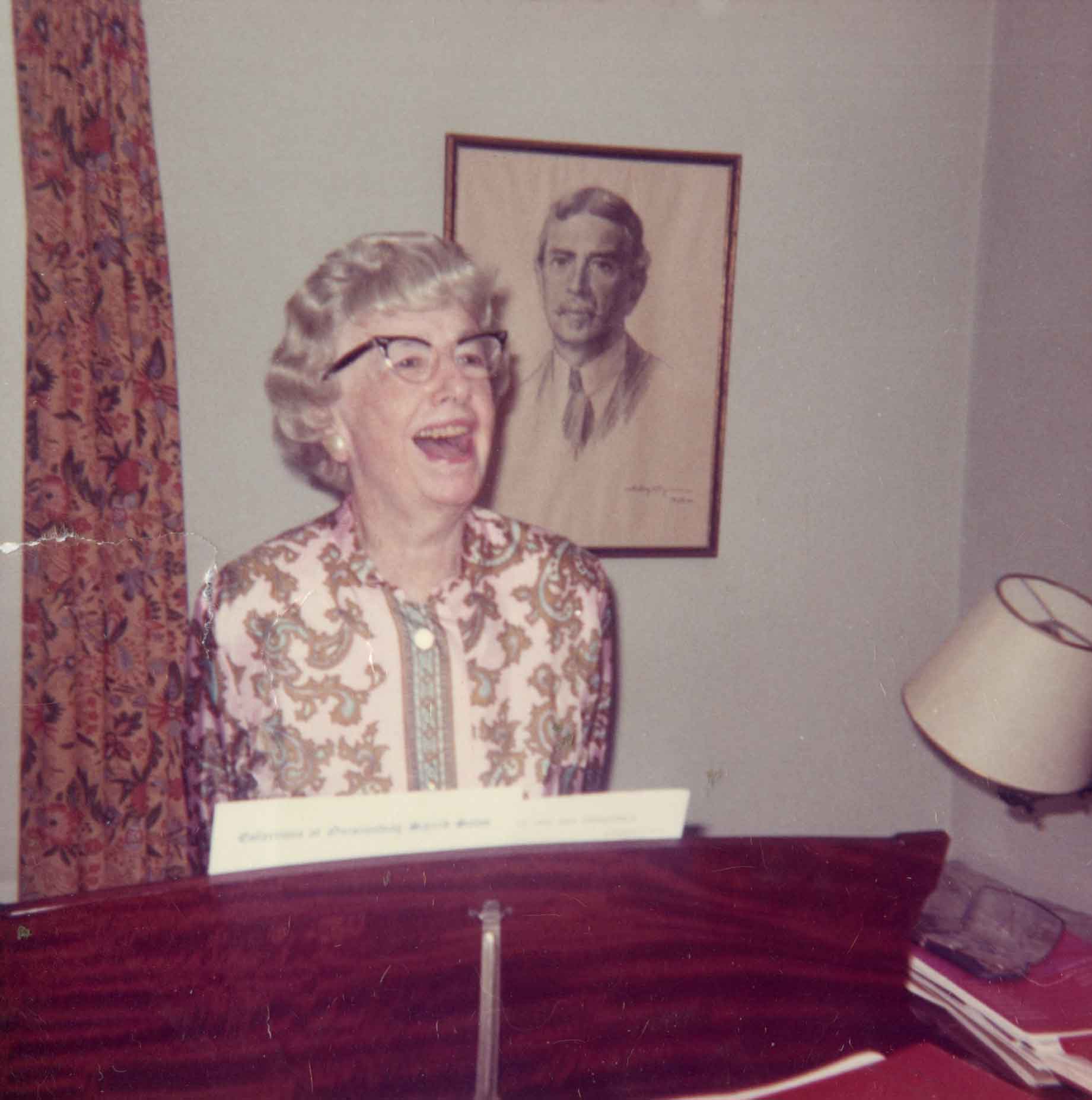
Katherine Kennicott Davis at the piano in her Concord home. Behind her is a portrait of Thomas Whitney Surette, with whom she studied.
| Courtesy of William Munroe Special Collections, Concord Free Public LibraryIn 1919, Davis moved to Concord to teach music at the newly opened Concord Academy, founded by fellow Wellesley alumna Anne Bixby Chamberlin. In Concord, she met Thomas Whitney Surette, a musician and scholar who ran a summer music school in the parish hall of the First Parish, where he also served as the organist. (He had played at Ralph Waldo Emerson’s funeral in 1882.) Davis attended his summer school and recalled that Surette’s mission was “to send out teachers full of the joy and magic of music, and able to pass it on.”2
In 1923, Davis was hired to teach choral music at Shady Hill, a school for girls in Philadelphia. Always more comfortable at the keyboard than at the blackboard, she left Shady Hill in 1930 after suffering what one biographer described as a nervous breakdown. She returned to Concord and devoted herself to composing choral music, both sacred and secular.
As a single woman without an inheritance to fall back on, she supported herself by writing music. Musical composition was considered a man’s job at the time, and she sometimes published as K. K. Davis to avoid the prejudice directed at women in the field. Because she was so prolific, she also felt compelled to publish under pseudonyms so it didn’t appear that she had written all of the pieces in a songbook.
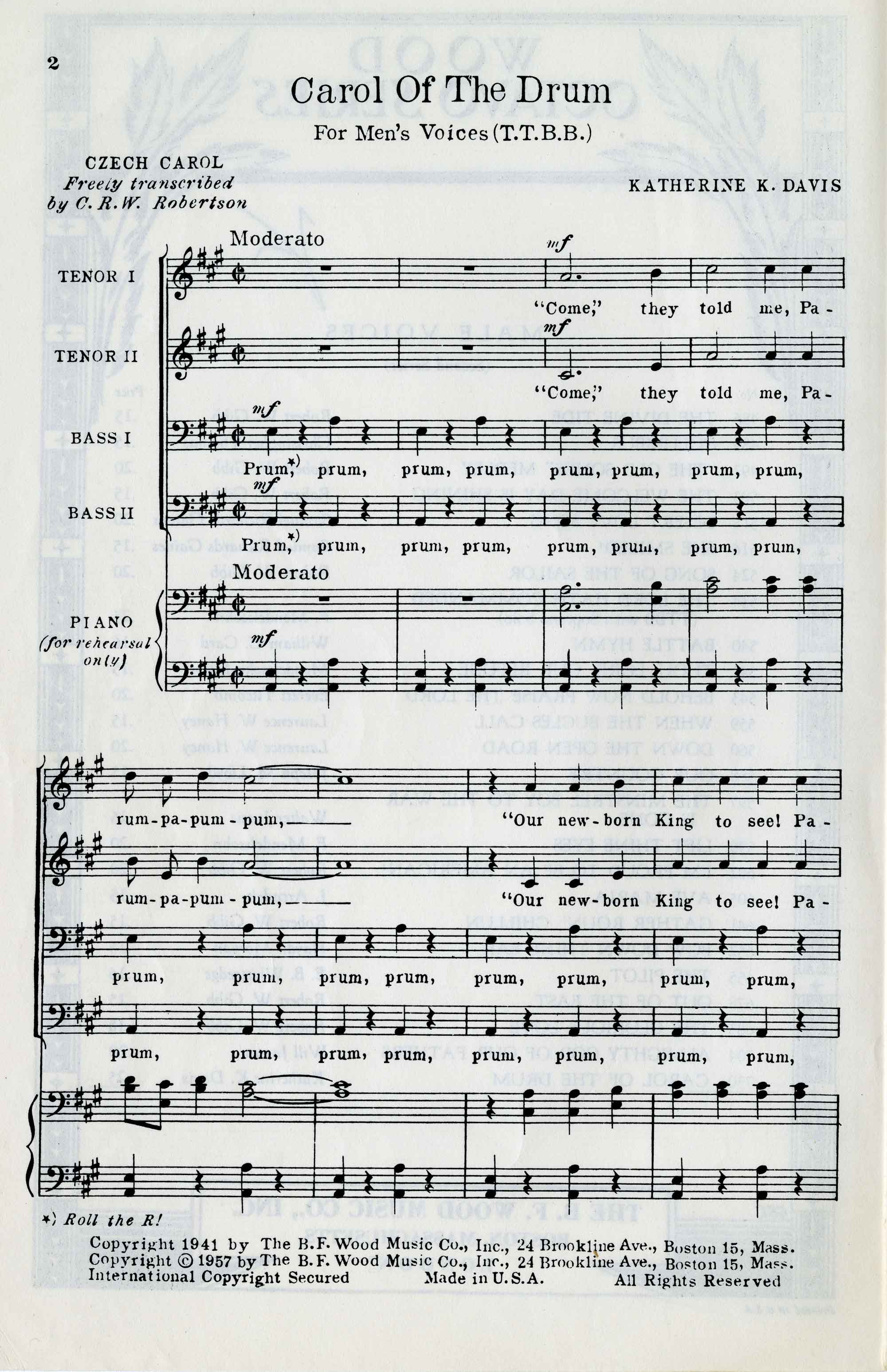
Score of “Carol of the Drum,” published in 1941
| Piano music courtesy of William Munroe Special Collections, Concord Free Public LibraryIn 1939, she met vocalist and teacher Nancy Loring, and this began a lifelong friendship and professional partnership. They shared a home in Concord, and Davis played piano to accompany Loring’s voice students. In 1945, Loring and Davis collaborated to present a choral concert of Brahms’ A German Requiem in Concord. It was so successful that it led to the foundation of the Concord Chorus, which still offers a program of music every year.
In 1941, Davis had an idea for a new song, inspired by the 18th-century French carol “Patapan” and the driving percussion of Ravel’s “Bolero.” The melody is in the tenor voice, while the basses sing an ostinato that mimics the sound of a drum. She called it “Carol of the Drum.” The music was her own, but she decided to label the lyrics as a modern translation of an old folk song, so she published it as a “Czech carol, freely transcribed by C. R. W. Robertson” (another Davis pseudonym).
Ten years after its publication, “Carol of the Drum” was recorded by the Trapp Family Singers, who were also under the impression that it was a Czech folk song. Their version didn’t attract much attention, but in 1958, the Harry Simeone Chorale made a recording with a new arrangement by Jack Halloran and a new title—“The Little Drummer Boy”—and it shot to Number 13 on the Billboard Hot 100 chart.
Then things got complicated. Since the original lyrics had been published with her invented attribution to Czech folklore, Davis had to go to court to prove that she had written them herself. In the end, she accepted an out-of-court settlement to share the royalties with Simeone and producer Henry Onorati.
The song’s continuing popularity inspired a television special in 1968. Davis didn’t like the show, which introduced themes of conflict and antagonistic characters.
In the 1960s, Davis, then in her seventies, was spending winters in Florida. In 1967, Stetson University in DeLand, Florida, awarded her an honorary doctorate in music. She continued to spend summers in Concord with occasional getaways to Vermont. On one such trip, she discovered that the television in her motel room could only get one channel. Her frustration vanished, however, when she saw that channel was showing a performance of Beethoven’s Ninth Symphony conducted by Eugene Ormandy. She took special pleasure in noting that the chorus was racially integrated—very progressive for the time.
A music student interviewed Davis in 1973, when she was eighty-one, and found her “alert, active, witty, and full of charm.”3 She was also still composing music. In 1979, a year before she died, Davis’ irreverent wit was still evident when she wrote from her nursing home in Littleton, “I pay less here than I would at the Deaconess [nursing home] in Concord where all the ‘best’ people go . . . I have new friends . . . who give me real talk.”4
Today, Concord visitors pay their respects to Katherine Kennicott Davis in Sleepy Hollow Cemetery, where she rests less than a third of a mile from the house where she lived.
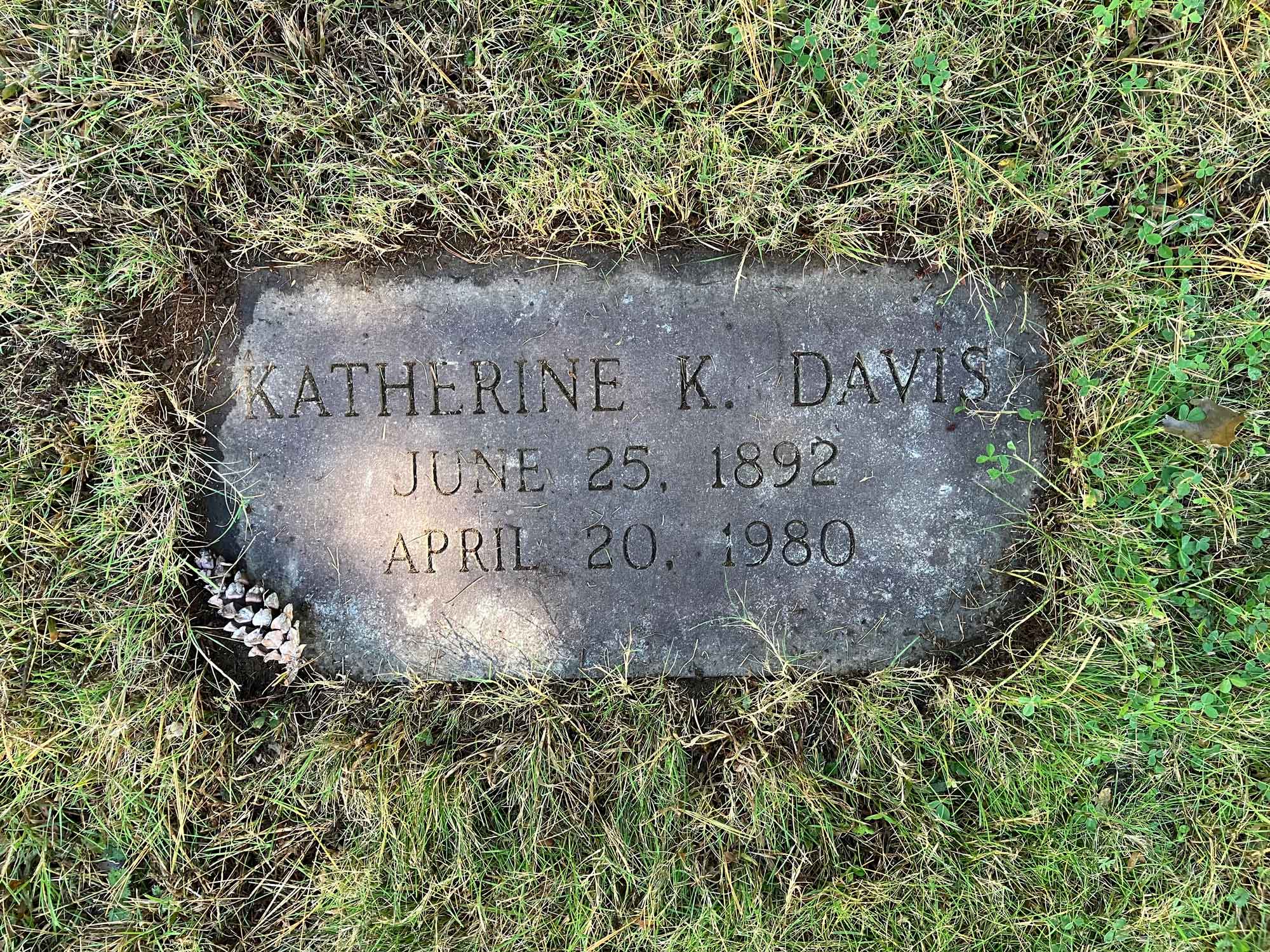 © Victor Curran
NOTES:
1. Katherine Kennicott Davis, “About Agnes,” 1953 unpublished autobiographical manuscript in William Munroe Special Collections, Concord Free Public Library. 2. Katherine Kennicott Davis, “Thomas Whitney Surette: A Biographical View,” unpublished undated manuscript in William Munroe Special Collections, Concord Free Public Library. 3. 1973 Christmas letter from the Boughton family, William Munroe Special Collections, Concord Free Public Library. 4. 1979 Wellesley College Class Record, Class of 1914.