
Between January and May 1776, Massachusetts occupied a critical juncture between rebellion and the emergence of a new nation. The final phase of the Siege of Boston coincided with the rapid dissemination of revolutionary ideology across local towns and communities, compelling residents to confront the extraordinary pressures of war. The experiences of Massachusetts residents during this period demonstrate that the pursuit of independence was shaped as much by hardship and sacrifice on the home front as by military developments on the battlefield.
By the winter of 1776, the military stalemate in Boston had transformed eastern Massachusetts into a strained war zone. Since the previous spring, the Continental Army’s siege had required local communities to balance extensive wartime mobilization with a deteriorating economy. As British and American military objectives conflicted, established trade networks, especially along the coast, collapsed under the strain of ongoing hostilities. British naval patrols and blockades restricted shipping, while the Continental Army’s substantial logistical demands diverted supplies from civilian markets. By May 1776, the Massachusetts government’s increased issuance of paper currency without specie backing further destabilized the economy. Communities that had previously depended on stable maritime commerce experienced sudden scarcity, and hyperinflation rates exceeding 25% emerged throughout the colony.1
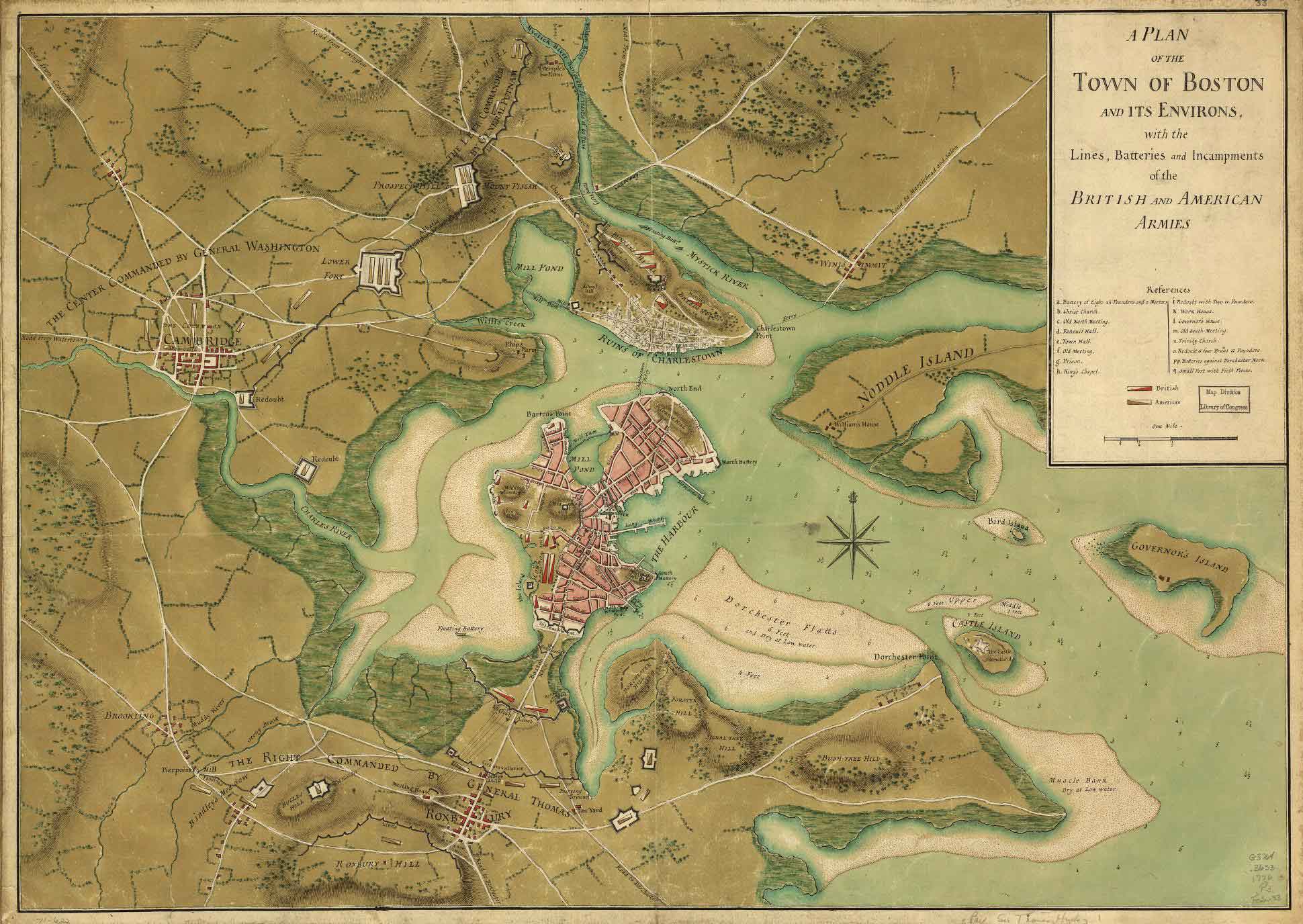
A plan of the town of Boston and its environs, with the lines, batteries, and incampments of the British and American armies, 1776
| By Sir Thomas Hyde Page. Library of CongressThe influx of displaced civilians fleeing Boston imposed additional burdens on towns already experiencing wartime shortages. Known as the “Donation People,” these refugees comprised hundreds of impoverished individuals, primarily women, children, the elderly, and the ill, who escaped the occupied city. Their arrival generated considerable financial strain on the host communities. For instance, residents of Newburyport petitioned Massachusetts authorities, asserting that the town could not support the Boston poor due to limited resources and demanded their relocation to “some of the farming Towns back of the seacoast.”2
The social tensions resulting from the war extended beyond economic hardship.
Hostilities toward individuals loyal to the Crown often escalated into harassment, intimidation, and violence. As revolutionary authorities consolidated power in Massachusetts, those suspected of supporting the enemy encountered mounting legal and social pressure. Early revolutionary legislation mandated that residents swear allegiance to the revolutionary cause, and individuals who refused to sign loyalty oaths faced disarmament, loss of voting rights, exclusion from certain occupations, or imprisonment.3 In numerous communities, these policies exacerbated preexisting mistrust. Loyalists traveling through these areas frequently encountered hostile crowds, and travel to neighboring regions, including visits to family members, was often denied or strictly limited. Incarceration or house arrest without due process protections became widespread, and property seizures occurred routinely.
The presence of prisoners of war introduced additional challenges to civilian life. British soldiers and sailors captured during combat or at sea were relocated to inland and coastal towns, often distant from active siege areas, for confinement. Communities including Newburyport, Concord, Worcester, Ipswich, and Plymouth were tasked with housing and guarding enemy captives, frequently relying on improvised facilities such as warehouses, open-air pens, or local jails. While American leaders sought to adhere to established laws of war, prisoners often endured harsh conditions, and the responsibility of guarding them placed further strain on already burdened communities. Supplies of food and clothing were inadequate, medical care was insufficient, and British soldiers and sailors routinely faced pressure to defect to the American cause.4
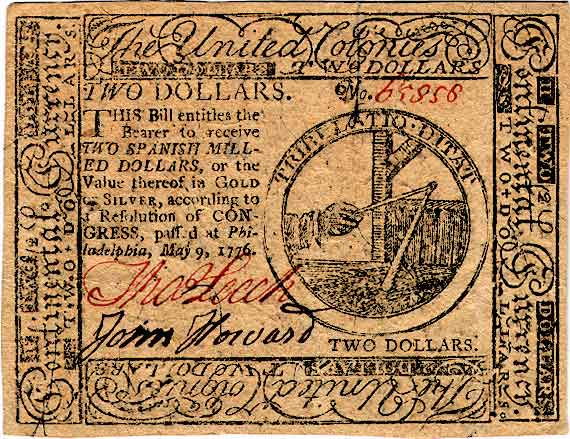
Continental currency $2 banknote (obverse) issued May 9, 1776
| University of Notre Dame via Wikimedia CommonsDiseases such as smallpox, camp fever, dysentery, and other contagious illnesses presented significant challenges to soldiers during the encirclement of Boston. The threat, however, was not confined to military camps. The frequent movement of soldiers, supplies, prisoners, and refugees between the siege lines and nearby towns created ongoing opportunities for contagion to spread into surrounding communities. For civilians in towns like Concord, the presence of the army provided protection from British forces but also introduced the alarming possibility that disease could accompany returning militiamen or passing travelers. Families who had already endured months of wartime disruption and scarcity now faced the risk that a single infected individual might trigger an epidemic in their town. Rumors intensified these anxieties, as reports circulated that British authorities might deliberately exploit the threat of contagion by permitting infected individuals to cross their lines. One American observer warned that British “soldiers try all they can to spread the smallpox, but I hope they will be disappointed,” reflecting a widespread belief that disease had become a weapon of war.5 Regardless of whether these actions were intentional or simply the result of wartime movement and crowded conditions, the perception alone heightened public anxiety and made communities increasingly wary of strangers, travelers, and even returning soldiers who might unknowingly carry infection from the camps.6
Massachusetts society exhibited significant contradictions concerning the concept of liberty. Enslaved men and women continued to live and work within communities that increasingly advocated for freedom and natural rights. In towns such as Andover, Lynn, and Lincoln, enslaved individuals performed diverse forms of labor, including maritime work and domestic service. Although legal protections were somewhat greater than those in the southern colonies, opportunities for enslaved people remained highly restricted. By 1776, many enslaved residents likely recognized the paradox of a revolutionary movement that denounced British tyranny while permitting human bondage within its own society.
Despite these hardships, revolutionary ideology continued to spread throughout Massachusetts. Pamphlets, newspapers, and public meetings stimulated debate regarding the possibility of reconciliation with Britain. The publication of Thomas Paine’s Common Sense in early 1776 accelerated this transformation by asserting that the colonies possessed both the right and the capacity to establish a new political order. By the spring of 1776, towns across Massachusetts were actively debating the prospect of independence. In Lexington, residents resolved that if the Continental Congress declared independence, the town “would stand ready with our Lives & Fortunes to support them in the Measure.”7
By June 1776, Massachusetts had been fundamentally transformed by the ongoing war.
Communities experienced economic instability, political division, and persistent demands to support the army. Civilians contended with shortages, disease, and an influx of refugees, while soldiers faced the challenges of siege warfare and the uncertainty of enlistments. Despite these hardships, a shared commitment to the revolutionary cause emerged.
—————————————————————————————
NOTES:
1 Truflation, “Inflation’s Defining Role in the American Revolution,” Truflation (blog), July 3, 2024, https://blog.truflation.com/inflations-defining-role-in-the-american-revolution/. 2 Peter Force, ed., American Archives, 4th ser., 3:1498 (Washington, DC, 1843), Digital Collections, Northern Illinois University, cited in Katie Turner Getty, “Displaced: The Donation People of 1775,” Journal of the American Revolution, October 18, 2017, https://allthingsliberty.com/2017/10/displaced-donation-people-1775/. 3 “An Act for the executing in the Colony of the several Resolutions of the American Congress, and of the House of Representatives of this Colony, etc.,” March 14, 1776, ch. VII, in The Acts and Resolves, Public and Private, of the Province of the Massachusetts Bay, vol. V (1775–1776), 31–32, 35, reproduced in Repository of Historical Gun Laws, Duke Center for Firearms Law, https://firearmslaw.duke.edu/laws/act-of-mar-14-1776-ch-vii-1775-1776-mass-act-at-31-32-35. 4 For an example of the treatment of British prisoners in Massachusetts during the early phase of the American Revolution, see Don Hagist, “Prisoners of War: Men of the 71st Regiment of Foot,” British Soldiers, American War (blog), June 6, 2009, https://redcoat76.blogspot.com/2009/06/prisoners-of-war-men-of-71st-regiment.html. 5 Elizabeth A. Fenn, “Biological Warfare in 18th Century North America: Beyond Jeffrey Amherst,” Journal of American History 86 (March 2000): 134. 6 Ann M. Becker, “Smallpox in Washington’s Army: Strategic Implications of the Disease during the American Revolutionary War,” The Journal of Military History 68, no. 2 (April 2004): 381–430. 7 Charles Hudson, History of the Town of Lexington, Middlesex County, Massachusetts, from Its First Settlement to 1868, vol. 1, History (Boston: Houghton Mifflin, 1913), 227.
