

Lucy Worsley, a historian and television presenter, is recognized for presenting complex historical topics in an accessible manner while maintaining their nuances. In the series Lucy Worsley Investigates, she undertakes the challenging task of explaining the ideological, political, and human dimensions of the American Revolution to a general audience. The series also addresses the significant chronological and military complexities of the conflict. This documentary is ambitious and frequently engaging, particularly in its examination of the intellectual and cultural origins of the Revolution.
A primary strength of Lucy Worsley Investigates is its effective integration of material culture. Many documentaries on the American Revolution rely predominantly on reenactments, broad narration, and contemporary political analogies. In contrast, Worsley consistently anchors the narrative in authentic 18th-century artifacts. Letters, newspapers, engravings, household items, coins, and personal possessions serve as integral elements of the storytelling. This methodology is significant because the American Revolution encompassed more than a succession of battles and declarations; it was a lived experience shaped by objects, symbols, and the dissemination of ideas through print and material culture.
The documentary’s incorporation of existing material culture helps viewers comprehend how ordinary individuals engaged with politics in the 18th century. Revolutionary ideology was disseminated not through television broadcasts or contemporary mass media but rather through pamphlets, tavern discussions, satirical prints, newspaper essays, and symbolic consumer behaviors. Worsley demonstrates that these artifacts were not merely passive remnants of the era; instead, they served as instruments in an ideological contest over liberty, representation, and constitutional authority. In this regard, the series distinguishes itself from many other interpretations of the Revolution.
Worsley’s most significant intellectual contribution is a focus on the concept of English constitutional liberty. The series avoids reducing the Revolution to a simplistic protest over taxes. Instead, Worsley examines the colonists’ belief that their constitutional rights as English subjects were threatened by corruption, centralized authority, and conspiratorial political influence within the British government. This broader ideological framework is crucial for understanding the dramatic escalation of resistance during the 1760s and 1770s.
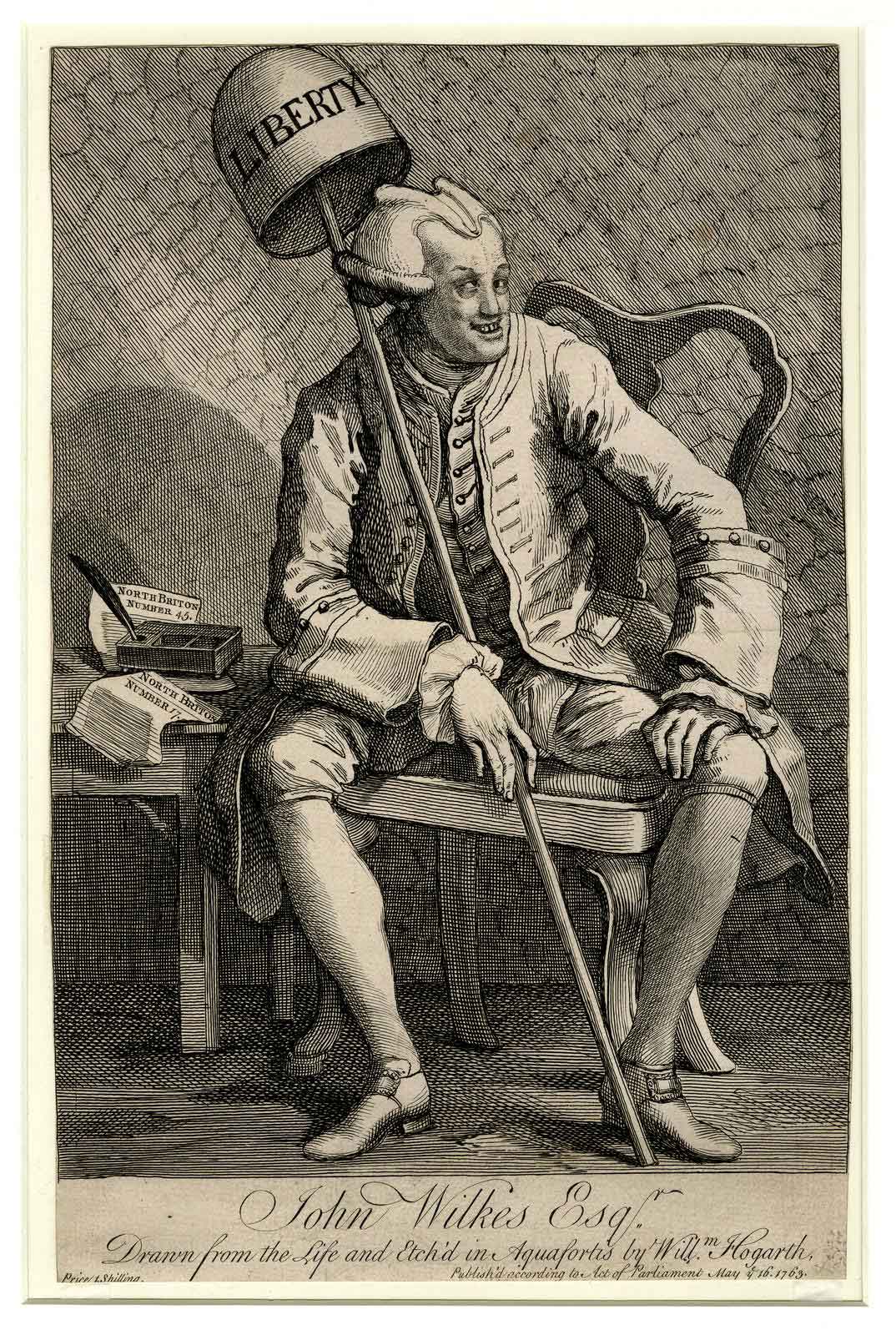
Caricatural portrait of John Wilkes holding the cap of Liberty, 1763
| Wikimedia CommonsThe inclusion of John Wilkes and the Wilkes, Liberty, and Number 45 movement is particularly significant. The slogan “Number 45!,” a reference to issue 45 of Wilkes’ newspaper, The North Briton, emerged as a transatlantic symbol of resistance to arbitrary authority and political corruption. By emphasizing Wilkes, the series effectively situates the American Revolution within the wider context of a British political crisis. New England radicals did not initially perceive themselves as creators of a new political philosophy; instead, many regarded their actions as a defense of traditional English liberties against ministerial corruption and unconstitutional overreach.
Wilkes’ fervor can even be found in 1769, in Lexington, where the women of the town proudly declared a boycott of all British goods in protest of the deprivation of civil liberties. As The Boston Gazette observed on August 31, 1769, “Very early in the morning, the young Ladies of [Lexington], to the number of 45, assembled at the house of Mr. Daniel Harrington, with their Spinning Wheels, where they spent the day in the most pleasing satisfaction.”1
This context is essential because it demonstrates that Revolutionary anxieties extended well beyond taxation policy. Colonists increasingly believed that unaccountable political interests within Parliament and the Crown posed a threat to the freedom of English subjects. Worsley’s analysis of these ideas clarifies why measures such as customs enforcement, the presence of standing armies in Boston, and parliamentary legislation provoked intense emotional and political opposition. The Revolution was fundamentally rooted in concerns regarding liberty, constitutional balance, and political corruption.
The series offers a thorough analysis of the Boston Massacre. Worsley carefully examines Paul Revere’s famous engraving and clarifies how the event became a propaganda victory for the American movement. Instead of depicting it as an isolated riot, the documentary places the Boston Massacre within a broader political context, highlighting its role in increasing colonial fears about standing armies and military occupation.2
The stationing of British troops in Boston after 1768 generated significant controversy.Colonists regarded standing armies during peacetime as potential instruments of tyranny—a perspective rooted in English constitutional history since the 17th century. Additionally, British regulars in Boston competed with local residents for employment when off duty, which contributed to declining wages in an already fragile economy. By highlighting the tensions resulting from military occupation, Worsley effectively conveys the pervasive suspicion and escalating hostility that characterized Boston in the years preceding open conflict. The Boston Massacre gained significance because Patriot leaders reframed a chaotic street confrontation as evidence of systemic oppression.
A significant achievement of Lucy Worsley Investigates is its comprehensive treatment of Benjamin Franklin. For decades, popular portrayals of the Revolution have often minimized Franklin’s central role during the imperial crisis of the 1760s and early 1770s. In contrast, Worsley positions Franklin at the center of the narrative. The incorporation of surviving letters, diplomatic materials, and personal artifacts provides valuable insight into Franklin’s gradual political transformation.
The series notes that Franklin was not initially an advocate for independence. For much of his political career, Franklin sought reconciliation within the British Empire, expressing admiration for the imperial system and believing that compromise was possible. His perspective changed markedly after the Hutchinson Letters Affair and his public humiliation before the Privy Council in January 1774. Franklin had secretly transmitted letters written by Massachusetts Governor Thomas Hutchinson calling for the restriction of colonial liberties. When these letters became public, Franklin was denounced in London and subjected to public ridicule before the Privy Council. This event fundamentally altered his relationship with Britain. Following this humiliation, Franklin abandoned loyalty to the Crown and began to support resistance and, ultimately, rebellion.
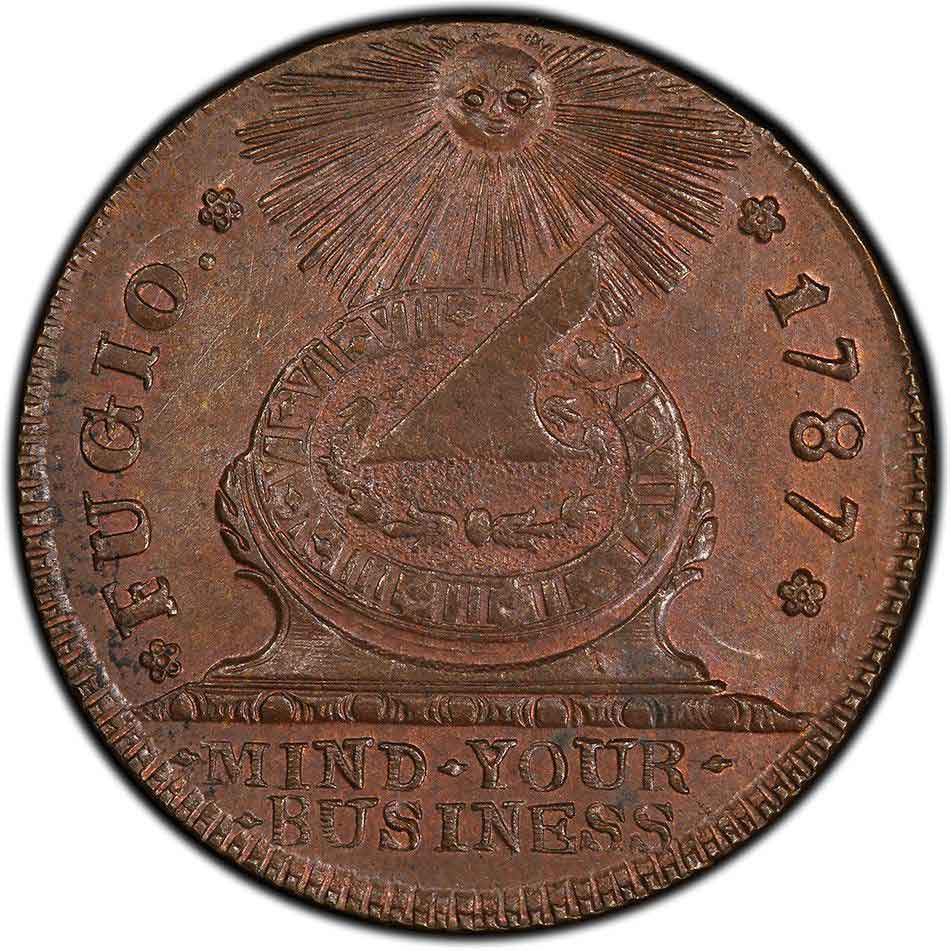
Fugio Cent, front
| Wikimedia Commons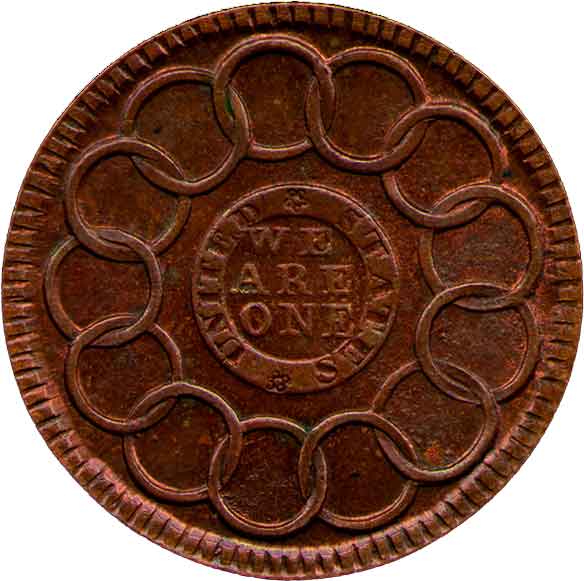
Fugio Cent, reverse
| Wikimedia CommonsThe inclusion of Lord Dunmore’s Proclamation highlights the ideological conflicts of the American Revolution. The proclamation granted freedom to enslaved individuals owned by rebel masters—but not to those owned by loyalists who escaped and joined British forces. Worsley smartly interprets this moment from the enslaved person’s perspective rather than only considering it as a military policy. The rhetoric of liberty during the Revolution coexisted with the harsh reality of slavery, and Dunmore’s Proclamation powerfully revealed these contradictions.
Equally effective is the documentary’s discussion of Thomas Paine and Common Sense. Worsley captures the extraordinary influence of Paine’s pamphlet in shifting colonial opinion toward independence. Paine’s argument was radical because it attacked the monarchy itself rather than merely criticizing parliamentary policy. By early 1776, many colonists still hoped for reconciliation, but Common Sense helped normalize the idea that independence was both practical and morally necessary. Most importantly, Common Sense laid out a road map toward independence and self-governance.
Similarly, the discussion of French intervention and the threat of invasion of the British homeland expands the audience’s understanding of the war as a global imperial conflict. The Revolution was no longer solely a colonial rebellion after France and Spain entered the war in 1778. Britain then faced threats across the Atlantic world and in Europe. By including the invasion of the Isle of Jersey in the narrative, Worsley demonstrates Britain’s increased vulnerability during the later stages of the conflict.
Lucy Worsley Investigates concludes with a compelling focus on Franklin’s Fugio Cent. This selection is particularly effective as the coin’s “Mind Your Business” and “We Are One” taglines symbolize both the emergence of a new nation and the enduring separation between Britain and the United States. Following years of conflict, political upheaval, and ideological struggle, the Fugio Cent came to represent a distinctly American identity forged in revolution.
Despite its many strengths, Lucy Worsley Investigates exhibits some limitations, particularly in its treatment of military history. The writers appear to have simplified 18th-century warfare, offering only limited discussion of tactics, logistics, siege operations, and conventional battlefield strategy. While guerrilla-style fighting certainly played a limited role in the Revolution, the war was also won through sustained European-style military operations—a complexity that the series only partially captures.
Additionally, at times, the portrayal of the Continental Army feels oversimplified, emphasizing images of poorly armed rebels with blunderbusses and pitchforks rather than the more complex reality of a force that, despite shortages, was largely equipped with muskets drawn from colonial production, captured British supplies, and later, French support. The documentary’s discussion of Lexington and Concord is also somewhat limited and, respectfully, incorrect.3 The British expedition of April 19, 1775, was primarily aimed at destroying military supplies at Concord—an important strategic objective that receives no attention in the series.
The series compresses the political timeline of the imperial crisis of the 1760s and 1770s to the point of neglecting significant developments such as the Coercive Acts. These laws included the closure of Boston Harbor, restrictions on Massachusetts self-government, suspension of civil rights, expanded troop quartering requirements, and provisions permitting colonists accused of crimes to be tried outside their colony. The enactment of these measures fundamentally transformed American resistance by persuading many Americans that constitutional liberties throughout the colonies faced a direct threat.
Nevertheless, Lucy Worsley Investigates offers a thoughtful, visually compelling, and intellectually rigorous examination of the ideological origins and global ramifications of the Revolution. The documentary’s principal achievement is its restoration of complexity to a conflict frequently oversimplified as a dispute over taxation. By skillfully incorporating artifacts, focusing on constitutional ideology, and highlighting transatlantic political movements, the documentary demonstrates that the American Revolution constituted a significant crisis concerning liberty, empire, and political identity, fundamentally transforming the Atlantic world.
NOTES 1 Boston Gazette and Country Journal, October 16, 1769, in “American Historical Newspapers,” Boston Public Library. Bpl.org. 2 As an aside, although Paul Revere is widely credited with creating the famous Boston Massacre engraving, historians now recognize that he closely copied the design from an earlier work by Henry Pelham. Pelham was furious that Revere published his version first in 1770, accusing him in a surviving letter of committing a “dishonourable” act by effectively stealing the image before Pelham could release his own engraving. Despite the controversy, Revere’s version became one of the most influential pieces of Revolutionary propaganda and remains far more famous than Pelham’s original work. “Paul Revere Copied the Boston Massacre Image?,” Paul Revere Heritage Project. Paul-revere-heritage.com/paul-revere-copied-boston-massacre-image.html. 3 The April 19, 1775, mission to Concord was not to arrest Massachusetts political elders as Worsley asserts. Instead, General Gage ordered military detachments to march on Concord. Specifically, in an April 18, 1775, order, Gage instructs Lt. Colonel Francis Smith of His Majesty’s 10th Regiment of Foot to “March with a Corps of Grenadiers and Light Infantry, put under your Command, with the utmost expedition and Secrecy to Concord, where you will seize and destroy all Artillery, Ammunition, Provisions, Tents, Small Arms, and all Military Stores whatever.” Orders from General Gage to Lieutenant Colonel Smith, April 18, 1775, in Vincent J-R Kehoe, The British Story of the Battle of Lexington and Concord on the Nineteenth of April 1775 (Hale & Company MM, 2000), 13.
