
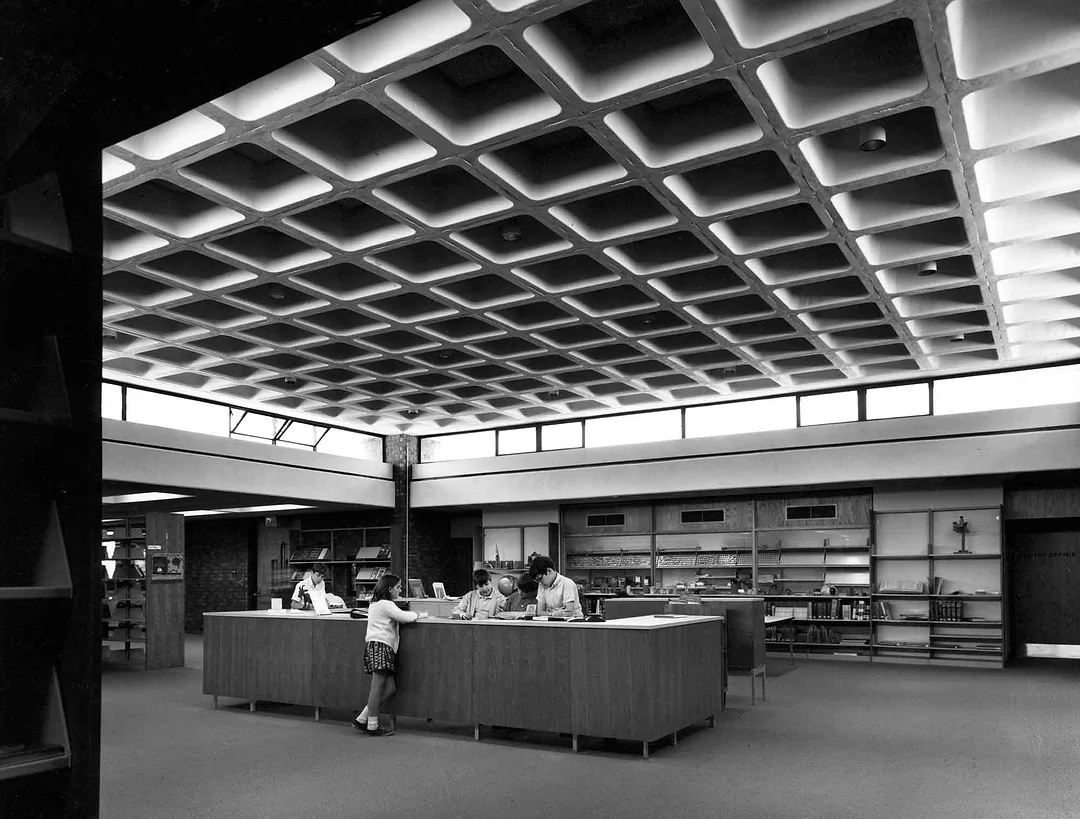
The Peabody Building is part of Concord’s mid-century modern architectural legacy. Designed in 1968 by The Architects Collaborative (TAC) as an elementary school, it was opened in 1970 and served (along with the Sanborn building) for 55 years as the Concord Middle School. This building is the physical manifestation of the mid-century architects’ aspirations for the elevation of our society, starting with children and the design of their environment.
The Peabody floor plan is a two-story cross, but because it is nestled into a hill, one arm of the cross has no lower level. It is surrounded by forest and greenery, which can be observed through ribbons of windows along each long wall. Exterior balconies on the second floor extend the interior experience beyond the walls and provide circulation to allow the interior spaces maximum programmatic flexibility. The center of the cruciform plan was meant to be a light-filled gathering and study space on the second floor and a nexus of circulation downstairs.
TAC grew organically from the Harvard Graduate School of Design (GSD), forming officially in 1945 when Norman Fletcher, Robert McMillan, Louis McMillen, and Benjamin Thompson joined Walter Gropius to form an experimental, egalitarian, architecture group practice where instructors and students worked on collaborative problem solving. Over fifty years, TAC designed thousands of schools and universities around the world.
The design philosophy of TAC, ambitious at the time, was that open spaces and flexibility of structures fostered independent and free-thinking people. John Harkness wrote in 1966 in The Architects Collaborative (published by Arthur Nigli, Switzerland):
“The will to understand and appreciate beauty and order must be generated within people. And this must be done during the formative years, which correspond generally to the years of public school education. The public school system in the United States is certainly one of the great corner stones upon which our democracy is built. Every society has created buildings which symbolize and epitomize its culture: in Greece – temples; in Rome – civic structures; religious buildings during the medieval period. I believe that the symbol of our society should be buildings devoted to education. Up to now, too few have been built worthy of this ideal.”
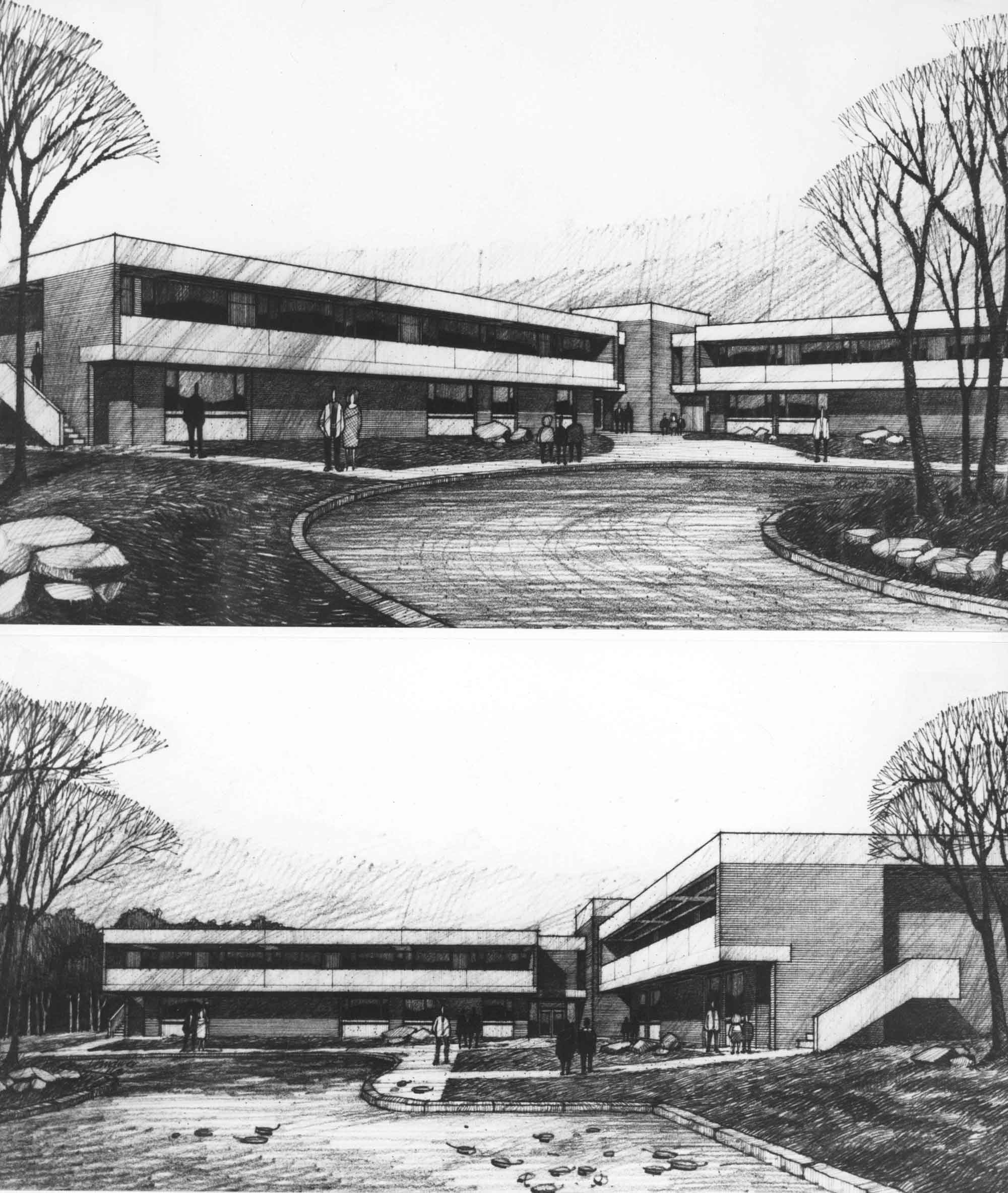
Views of the Main Entrance to the School, 1968, TAC
| © 2010 MIT. Courtesy of MIT Museum.Designing the Concord Elementary School was an opportunity for TAC to execute this philosophy. According to the Concord Elementary School Design Review presentation of Sept. 13, 1967, at the “Mid Oct Town Meeting”, the design objectives were laid out by the TAC presenters:
“In any community the school system is the most important agency in that community and has the greatest responsibilities. The very nature and in a sense the philosophy of the community provides direction for creating a place where people live and learn.
The town of Concord, with a strong heritage in literature and in story, provides such direction in two very important areas: independence and experimentation.… The Concord School System, above all, would be unworthy of the name of the community if it did not have as the bases of its operation the goal of producing independent students emotionally, socially and intellectually and the concomitant goals of willingness to experiment and to lead.… To do this we must create an environment where that individual may function freely.
Such an atmosphere comes about in two parts. One in human contacts – peer relations and adult relations must exemplify an open, accepting attitude, and the other in that the very structure containing these individuals must be designed to encourage and foster this attitude.
Open space or loft-type construction will provide a large unbroken area so that the instructional program will include many opportunities for individual pursuit, for experimentation, for discussion and for thinking…. The organization created by open space will change constantly to take advantage of teams, consultants, large groups, small groups and individual study, for we will be concerned with maximum individual growth – complete, comfortable and efficient…. The learning centers, (alias schools) will be open year-round and the resources of the learning center will be available day and night for the entire community.”
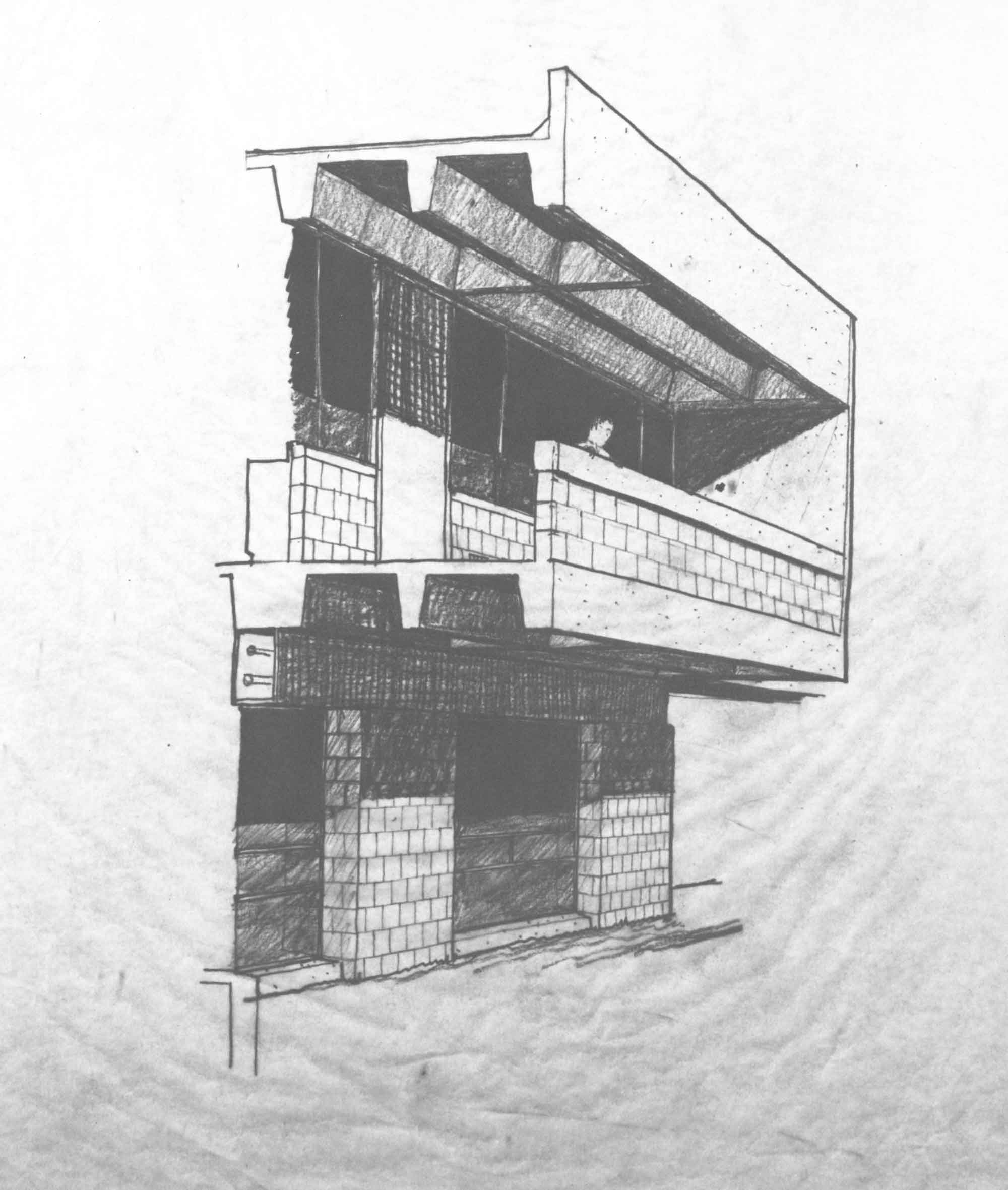
The Peabody Building Balcony Schemes, 1968, TAC
| © 2010 MIT. Courtesy of MIT Museum.This was the essence of the design of the Peabody Building – a flexible structure to encourage the growth of independent, free-thinking leaders. It was to serve the whole community with programming after school and resources available to all. These goals for our education system are still with us today in the Concord Schools. The Peabody building was a success. In 1971, the jury of the Exhibition of School Architecture characterized it as an: “open plan elementary school with distinctive character, designed to serve a changing educational program…. [The] two-floor plan ingeniously separates noisy, active areas at the lower level from upper-level instructional spaces which are grouped around a central resource center. Thoughtfully planned to serve the community well on a long-range basis.”
The Peabody could continue to serve our community. The 55,000 sqare foot building has a structure of post-tensioned concrete beams and concrete piers, which was designed under codes more conservative than current ones for reinforced-concrete buildings. It was updated to meet ADA code requirements in the 1990s with accessible bathrooms, ramps, and an elevator. The boiler is new, and the windows were replaced in 2010. According to a study conducted by Feingold Alexander, published in January 2017, the building is in satisfactory condition. Outside of a few patches, replaced finishes, some removable partition walls and drop ceilings, the building design has remained unchanged since it opened.
Walking through the Peabody, one can experience the architects’ vision for elementary school children as well as for adults in a collaborative office environment. It is easy to find one’s way through the building by sight paths down the four wings and glimpses of outdoor landmarks through the many windows. The sun traces a path over the course of the day which is evident from all the spaces inside. The simple design of the building and scale of the ceiling heights and widths of the space make a person feel safe to concentrate on what s/he is there to do. The natural environment is invited in enough to feel peaceful but not so much as to be distracting. The whole building serves the work of the inhabitant, not merely as a testament to the designer or to the fabricated importance to a particular style or form. This is the essence of good modern design: it has outlasted the original designers, and it will outlast us as well.
Today, the structure is largely empty and awaiting a verdict on its future. We, the residents of Concord, should consider a plan to give new purpose to this once-delightful building. Let us honor the design vision of our local celebrity architects of the modern era and add the Peabody to the list of historical structures in Concord and preserve its “grand design” for future generations.
