Discover Concord Logo
Toggle Mobile MenuToggle Mobile Menu
Subscribe
  • Home
  • Current Issue
  • Back Issues
    • Fall 2025
    • Spring 2025
    • Winter 2025
    • 2024 Back Issues
    • 2023 Back Issues
    • 2022 Back Issues
    • 2021 Back Issues
    • 2020 Back Issues
    • 2019 Back Issues
  • Browse Topics
    • Abolitionism in Concord
    • American Revolution
    • Arts & Culture
    • Celebrity Profiles
    • Civil War
    • Concord History
    • Concord Writers
    • First Nations People of Concord
    • Historic Sites in Concord
    • Parks & Nature
    • Patriots of Color
    • Things to See & Do
    • Transcendentalism
    • Trivia
    • Untold Stories of Concord
  • Plan Your Visit
  • Events
  • Purchase Subscriptions and Back Issues
  • Discover the Battle Road
  • 250 Collectibles
  • Trading Cards
  • More
    • About Us
    • Advertise
    • Contact Us
Toggle Mobile MenuToggle Mobile Menu
Home » Keywords » william dawes

Items Tagged with 'william dawes'

ARTICLES

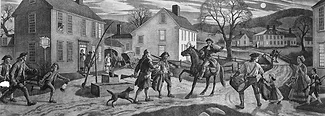
FWA-PBA-Paintings_and_Sculptures_for_Public_Buildings,_painting_depicting_the_midnight_ride_of_Paul_Revere-artist..._-_NARA_-_196560.jpg

Paul Revere’s Other Riders

March 28, 2025
Ray Raphael
No Comments

Myth:

“Alerted by signal lanterns, express riders Paul Revere and William Dawes eluded British patrols and spurred their horses toward Lexington along separate routes to warn Hancock and Adams.”1

“When Revere and fellow patriot William Dawes saw two lights shine, they set off on horseback. Using two different routes out of Boston, they sounded the alert.”2 

Busted:

Neither Paul Revere nor William Dawes received news of the Regulars’ advance by signal lanterns. In his classic “Paul Revere’s Ride,” published in 1861, Henry Wadsworth Longfellow exercised considerable poetic license with his legendary “One if by land, two if by sea” drama. 


Read More
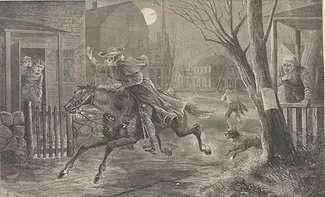
Paul-Revere's-Ride---Charles-Green-Bush-TIFF-file.jpg

The Midnight Ride: Forewarned is Forearmed

March 28, 2025
Alexander Cain
No Comments

In late winter and early spring of 1775, General Gage, the British military governor of Massachusetts, received orders from London to arrest colonial leaders and seize rebel arms and ammunition stockpiles. Contemplating his options, Gage prioritized the recovery of four brass cannons, which had been stolen from Boston and reportedly hidden in Concord, along with stockpiles of muskets, ammunition, and gunpowder. His plan called for seven hundred elite troops under Lieutenant Colonel Francis Smith to march to Concord on the evening of April 18, with orders to destroy all military supplies while minimizing harm to civilian property. A small party of officers was also dispatched ahead to intercept any messengers, ensuring no warnings reached Concord ahead of the troops.


Read More
The-Acton-Minutemen-fore-a-volley-from-the-hill-at-NARA-Park-Winter-Carnival-2017.jpg

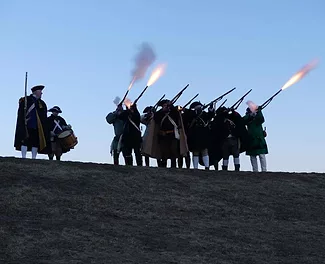
“I Haven’t a Man Who is Afraid to Go”: The Acton Minutemen on April 19, 1775

September 15, 2023
Steve Crosby
No Comments

The Acton Minutemen were formed at the end of 1774 at a town meeting. Tensions with England had grown to a boil, and towns everywhere were responding by training their men to fight. The town of Acton, which had previously been part of Concord, chose their best men from their existing militia units to form the new Minute Company, and those men voted 30-year-old Isaac Davis as their Captain.

Read More

Featured Stories

  • Cover Spring26.jpg

    The Spring Issue is Here!

    Patriots' Day is almost here, and this issue of Discover Concord brings you a list of events, the parade route, and much more to make your celebration special.  Also in this issue is an in-depth look at the new PBS documentary "Henry David Thoreau," a fascinating piece on how the Concord Lyceum came to be, and a look at how Massachusetts civilians on the homefront managed the challenging months of January - May 1776. Freedom's Way National Heritage Area is launching an exciting program you won't want to miss called "Declaring Independence: Then & Now" in more than 20 towns across Massachusetts. With two special fold-out inserts,  maps, lists of shops, and so much more, you'll want to get your copy early!
  • Mural.jpg

    West Side Story

    Concord Center takes justifiable pride in its history, but today great things are happening in West Concord. Innovation and self-reliance are nothing new on the west side of Route 2; they’ve defined the community for centuries. 
  • Concord-Town-Hall-1875-from-Concord-Library.jpg

    Established for Social & Mutual Improvement: The Concord Lyceum

    The Lyceum Movement started in New England in 1826, when educator and scientist Josiah Holbrook founded the first lyceum in Millbury, Massachusetts. Inspired by the classical Lykeios (Λύκειος) in Ancient Greece, where Aristotle taught, the movement was created to bring education to ordinary people through lectures, debates, and readings. Lyceums quickly spread across New England, fostering education, self-improvement, and civic engagement, and many towns soon formed lyceums of their own, including Boston in 1829 and Salem in 1830. By the 1830s, there were Lyceums across the country. 
©2026. All Rights Reserved. Content: Voyager Publishing LLC. Design, CMS, Hosting & Web Development: ePublishing
Facebook Instagram