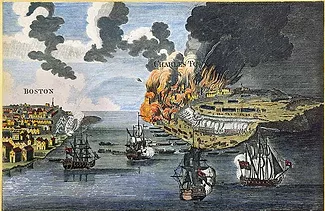
The Battle of Bunker Hill, fought on June 17, 1775, marked a critical moment in the American Revolution. It was part of the Siege of Boston, an early and bloody conflict between British forces and American colonists.
After the bloody events at Lexington and Concord on April 19, 1775, the New England militia began to encircle Boston, placing the British garrison under siege. Before the American Revolution, troops in Boston relied heavily on local farmers for fresh provisions. General Thomas Gage would be forced to depend upon a long and tenuous supply line to Nova Scotia and England if these local supply sources were disrupted. Massachusetts leaders understood that it was unlikely that they could entirely cut off the flow of supplies to the British army. Still, if they could significantly cut into it, they might starve the British out of Boston.
The Battle of Menotomy was a skirmish fought as the British retreated to Boston on April 19, 1775. The fight, often overshadowed by the Battles of Lexington and Concord, was brutal and bloody.
After the Battles of Lexington and Concord, British troops retreated to Boston. However, they were relentlessly harassed by thousands of militiamen who ambushed them from the surrounding woods and houses. The British soldiers, now under constant fire, were forced to slow their pace and fight their way back to safety.
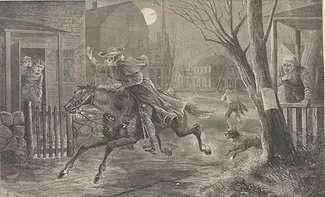
The Battles of Lexington and Concord, fought on April 19, 1775, marked the outbreak of the American Revolutionary War. The British, seeking to suppress a growing colonial rebellion, dispatched 700 elite troops under the command of Lieutenant Colonel Francis Smith to seize a stockpile of arms and ammunition in Concord, Massachusetts. News of this impending operation quickly spread through the colonial network, alerting local militias.
The operation began with British troops crossing the Charles River to Cambridge and marching toward Concord under darkness. The confrontation began at Lexington Green, where a small contingent of colonial militiamen, under the command of Captain John Parker, faced a significantly larger British force. As the Regulars approached the town common, Parker told his men to “Stand your ground, don’t fire unless fired upon, but if they mean to have a war, let it begin here!”1
In 1774 when Parliament passed the Boston Port Act in an attempt to break the Massachusetts colonists of their resistance to Crown policy, it also authorized English General and acting Massachusetts Governor Thomas Gage to undertake any military measures necessary to help bring the colony under control. In late winter and early spring of 1775, Gage received a series of dispatches from London ordering him to not only arrest the leaders of Massachusetts’ opposition party but to launch a major strike against the apparently growing provincial stockpiles of weapons and munitions located throughout eastern Massachusetts. As he contemplated these orders, Gage considered a variety of military options, including a long-range strike against the large store of weapons located in the shire town of Worcester, forty miles west of Boston.
In 1774, a war between England and Massachusetts Bay Colony appeared inevitable. In preparation, Massachusetts militiamen relied upon muskets obtained from various sources: inheritance, the French and Indian War, the Siege of Louisbourg, and commercial markets.
The result was a variety of weapons of different caliber, origins, and values.
Thus, as Massachusetts soldiers marched off to war on April 19, 1775, it would not have been uncommon within the same militia company to see hunting guns, English muskets, Dutch muskets, American-made muskets (with parts from several sources), and French muskets.
In late winter and early spring of 1775, General Gage, the British military governor of Massachusetts, received orders from London to arrest colonial leaders and seize rebel arms and ammunition stockpiles. Contemplating his options, Gage prioritized the recovery of four brass cannons, which had been stolen from Boston and reportedly hidden in Concord, along with stockpiles of muskets, ammunition, and gunpowder. His plan called for seven hundred elite troops under Lieutenant Colonel Francis Smith to march to Concord on the evening of April 18, with orders to destroy all military supplies while minimizing harm to civilian property. A small party of officers was also dispatched ahead to intercept any messengers, ensuring no warnings reached Concord ahead of the troops.
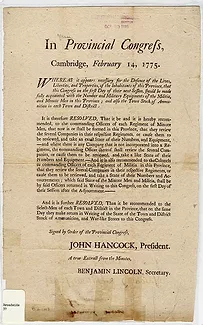
The Massachusetts Provincial Congress was a revolutionary governing body that played a crucial role in the lead-up to the American Revolution. Formed in response to escalating tensions with Great Britain, it served as a de facto government for the colony, exercising powers that had traditionally belonged to the British-appointed governor.
On October 5, 1774, over ninety representatives from the various Massachusetts county conventions met in Salem in defiance of General Thomas Gage’s dissolution of the Massachusetts Colonial Legislature. Upon learning of the meeting, Gage attempted to shut down the meeting but failed. Acting upon the advice of the various county conventions and resolves, especially the Suffolk Resolves, the representatives quickly voted to organize themselves into a “Provincial Congress…to take into consideration the dangerous and alarming situation of public affairs in this province, and to consult and determine on such measures as they shall judge will tend to promote the true interest of his majesty, and the peace, welfare, and prosperity of the province.”1 The representatives remained in Salem for a few days and then quickly adjourned to reconvene in Concord, Massachusetts.
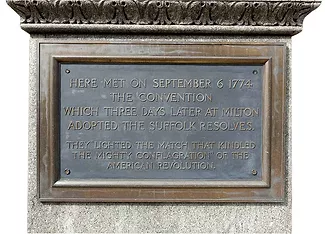
When General Thomas Gage dissolved the Massachusetts Colonial Legislature on June 21, 1774, many communities throughout the colony demanded that town and regional committees be organized to counter Gage’s actions and form a constitutional government that would protect their rights and liberties. By late August, correspondence committees across the colony called for representatives from every town to organize county conventions and draft resolutions outlining the strategy and legal justification for opposing Crown policy.
The Massachusetts Court Closures of 1774 marked the escalation of Massachusetts’ resistance to British authority. The closures were a direct response to the Coercive Acts (also known as the Intolerable Acts), a series of punitive measures passed by the British Parliament in 1774. Among the measures was the Massachusetts Government Act, which severely restricted colonial self-governance by placing the judicial system under the direct control of the royal governor and eliminating town meetings without prior approval. Many colonists believed that this act infringed their rights and autonomy as British citizens.